Experimental and infused coffee processing changes how coffee tastes by controlling fermentation, applying temperature treatments or introducing other ingredients. The crucial distinction is between changing the conditions around the coffee and adding materials intended to influence its flavour: both deserve a clear explanation on the bag.
In short
- Yeast inoculation introduces selected microorganisms, not necessarily fruit or flavouring.
- Extended fermentation describes extra processing time, not a guaranteed improvement in quality.
- Thermal shock uses contrasting water temperatures; ask for the actual treatment rather than relying on the name.
- Co-fermentation and infusion can overlap, so useful labelling names the additions and when they were used.
- World Barista Championship rules from 2024 onwards permit processing additions before the defined green-coffee stage, while prohibiting additions after it.
What counts as experimental coffee processing?
“Experimental” is best read as an umbrella description, not a complete processing method. It might mean a selected yeast culture, a longer fermentation, a temperature-controlled sequence or fermentation with added fruit. Those interventions are different enough that the word alone tells you little about what happened.
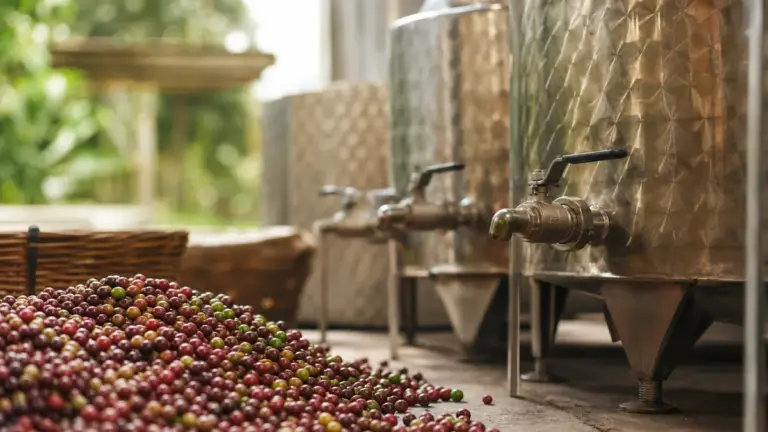
Fermentation is the activity of microorganisms transforming substances around the coffee, including sugars in the fruit and its sticky mucilage. Their activity changes the chemical environment and can influence the eventual cup. Experimental processing makes particular parts of that activity more deliberate.
For the underlying processing routes, start with coffee processing methods. Here, the useful questions are narrower: what was changed, what was added, and how convincingly can the resulting flavour be explained?
A practical guide to the labels
Treat the final column as a buying checklist, not a formal classification system.
| Label | What it describes | What to ask |
|---|---|---|
| Yeast-inoculated | Selected microorganisms introduced into fermentation | Which culture, and what else accompanied it? |
| Extended fermentation | A deliberately prolonged fermentation stage | How long, under what conditions, and with what endpoint? |
| Thermal shock | Treatment with contrasting water temperatures | Which temperatures, for how long, and at which stage? |
| Co-fermented | Fermentation involving added materials or cultures, depending on usage | Exactly what was added? |
| Infused | A description signalling deliberate flavour introduction | Which ingredients or flavourings, and when? |
These categories need not be mutually exclusive. A producer can inoculate coffee, ferment it for an extended period and then apply a temperature treatment to the same lot.
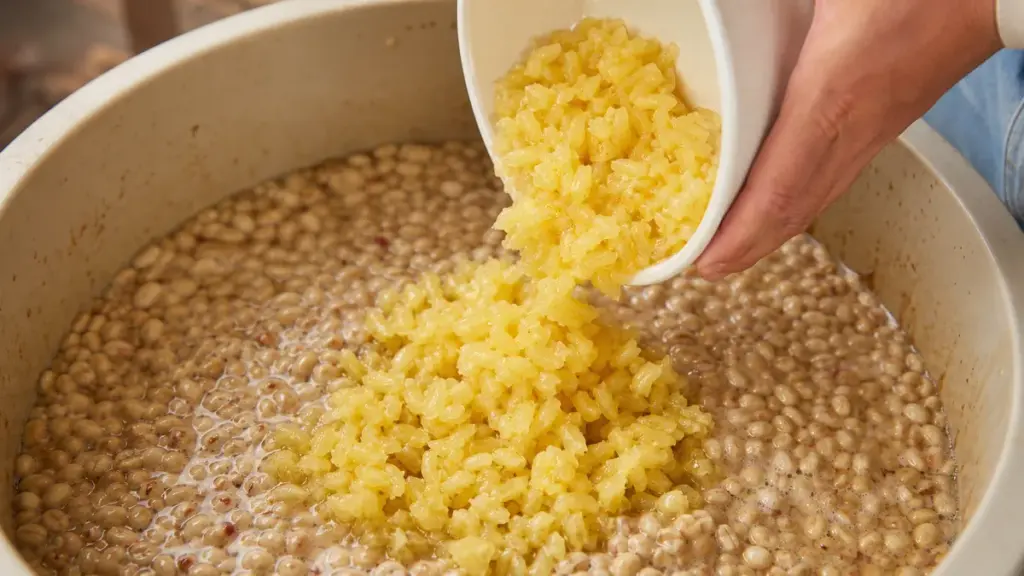
Yeast inoculation: choosing the microorganisms
Yeast inoculation means adding a selected yeast culture to steer fermentation rather than relying entirely on the microorganisms already present. A starter culture is the preparation used to introduce those organisms. Researchers have investigated species including Saccharomyces cerevisiae and Torulaspora delbrueckii in coffee processing.
The mechanism is more specific than “yeast makes coffee fruity”. Different microorganisms produce different mixtures of acids, alcohols and aroma compounds as they metabolise available nutrients. Their effects also depend on the coffee and processing environment.
A controlled study published in Food Bioscience in 2023 compared inoculated and uninoculated treatments in natural and pulped coffee. Different yeasts produced different sensory results, with the highest-scoring yeast treatment differing between those processing routes. That supports culture selection for a particular system, not a universal best yeast.
Adding microorganisms is also not automatically equivalent to adding a fruit flavouring. However, “yeast-inoculated” is incomplete disclosure if the culture arrives with other ingredients. Ask what the starter contained, not merely which microorganism was named.
Extended fermentation: time needs context
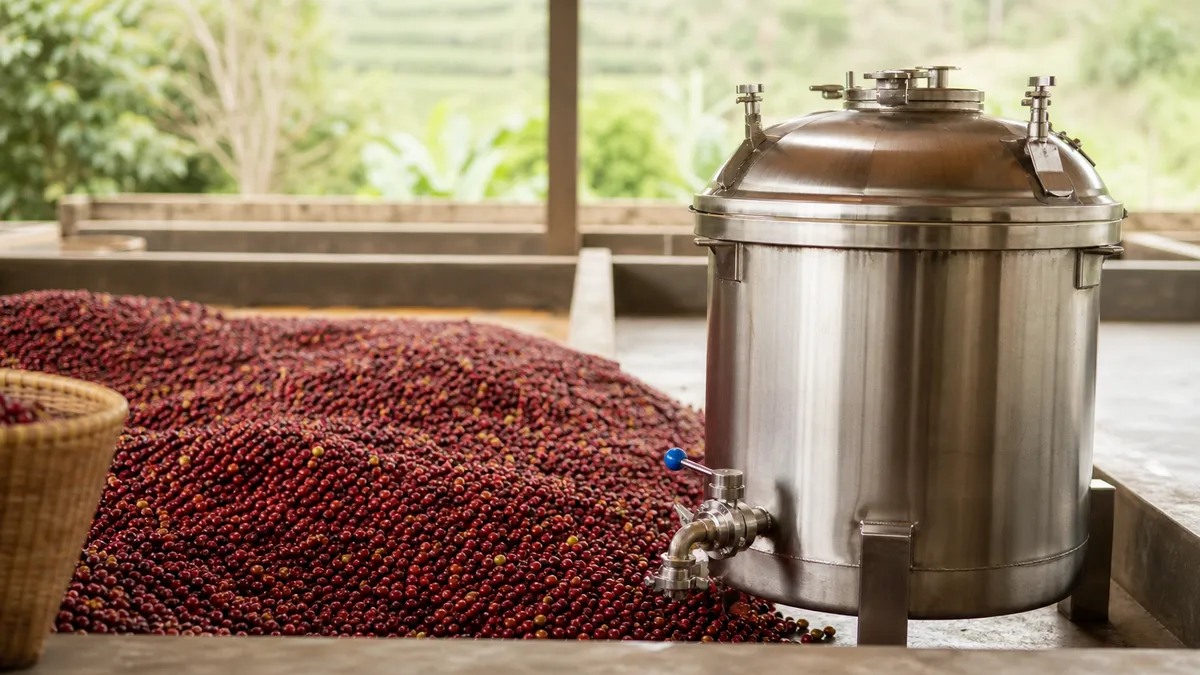
Extended fermentation means keeping coffee in a fermentation stage longer than the producer’s comparison process. For a useful description, the duration needs to be accompanied by information about the starting material, temperature, oxygen conditions and any inoculation.
In a controlled 2024 study, researchers compared spontaneous and yeast-inoculated fermentations lasting 0, 24, 48, 72 and 96 hours. The sensory profiles changed with both time and inoculation. Inoculated coffee showed stronger fruity dominance at 72 hours, while the 96-hour treatment also produced herbaceous notes.
The lesson is not that 72 hours is an ideal recipe. It is that extra time changes the process, and the result depends on the system being studied. “Longer” is a description, not a quality grade.
When comparing two bags, ask what the stated hours include. Is that one continuous stage, or the total across several stages? A useful process sheet should make that distinction explicit.
Long fermentation need not mean oxygen-limited fermentation. Our anaerobic fermentation explainer covers that separate variable, while carbonic maceration explains another named approach that should not be treated as a synonym for extended processing.
Thermal shock: ask what actually happened
Thermal shock is a temperature-treatment label rather than a sufficiently detailed recipe. A useful lot description should identify the warmer and cooler treatments and their place in the processing sequence.
For example, direct importer and roaster Velvet describes a Wilton Benitez Chiroso lot receiving water at 40 degrees Celsius followed by water at 12 degrees Celsius after fermentation. These are the seller’s published processing details, checked in November 2026, not an independently validated optimum.
The same description explains the treatment through beans’ pores opening and closing to retain aromas. That explanation should be treated as a supplier claim, not an established mechanism demonstrated by the process sheet.
Keep the observable operation separate from its proposed explanation. “Water at these temperatures, applied at this stage” is useful information. A claim that the treatment traps particular aromas needs additional evidence.
Nor does the label alone establish that a coffee was infused. To answer that question, the producer or seller needs to disclose additions separately from temperature management.
Co-fermentation and infusion: where the distinction blurs
For buying purposes, it helps to distinguish three things:
- Microbial inoculation: introducing selected microorganisms.
- Fermentation with additional ingredients: introducing materials such as fruit alongside the coffee.
- Deliberate flavour introduction: using an ingredient or flavouring to impart a particular sensory character.
These are working distinctions for this article, not an official industry standard. Published research itself uses “co-fermentation” in discussions of mixed starter cultures, demonstrating why the term needs an accompanying ingredient description.
Can added ingredients affect the beans directly?
Controlled laboratory research has demonstrated that selected aroma compounds can move from a surrounding liquid into coffee seeds under simulated wet-processing conditions. The parchment, the protective layer around the seed, affected transfer, while some compounds also underwent reactions within the beans.
This means it is too simple to claim that every flavour change must come only from microbes consuming added fruit. Transfer from the surrounding medium is possible. Equally, that experiment does not prove that any particular commercial fruit-fermented coffee owes its roasted flavour mainly to direct transfer.
The relative contribution of microbial activity, transferred compounds and later processing needs evidence specific to the treatment.
Why some studies cannot isolate the fruit’s effect
A study published online in December 2025, in the January 2026 issue of mSystems, compared spontaneous fermentation with a treatment containing a starter culture and pineapple. The starter preparation also contained wheat flour and raw sugar.
The treated coffee received more favourable sensory assessments, but several variables changed together. The experiment therefore cannot tell us what pineapple alone contributed, or attribute the result solely to the named yeast.
That distinction matters when research becomes marketing. Evidence that a combined treatment changed a coffee is not proof that one ingredient caused every advertised tasting note.
Transparency and labelling: separate process from flavour
A tasting note describes a sensory resemblance. World Coffee Research’s Sensory Lexicon provides references for describing coffee attributes; those references are not an ingredient list.
“Strawberry” on a tasting panel and “strawberry added during fermentation” therefore answer different questions. Good communication should make both answers easy to find.
Our editorial position is that neither experimentation nor infusion is inherently a reason to dismiss a coffee. The objection is to withholding information that would change a reader’s understanding of what they are drinking.
There are two reasonable priorities in the debate. One buyer wants flavour to reveal the coffee’s growing conditions and variety as directly as possible. Another welcomes processing-led flavours as an expression of the producer’s skill. Those preferences can coexist when the intervention is disclosed.
What a useful process description should include
Before choosing experimental and infused coffee, look for:
- The starting material: whole cherries, pulped coffee or another clearly identified stage.
- The additions: cultures, fruit, sugar, spices, extracts or other materials, where used.
- The sequence: when additions and temperature treatments occurred.
- The conditions: fermentation duration, temperature and oxygen management.
- The distinction between ingredients and tasting notes: what was introduced versus what tasters perceived.
This is a recommended disclosure checklist, not a statement of mandatory UK labelling requirements. A proprietary process name is not a substitute for those answers.
What competition rules allow
The World Barista Championship’s 2024 rules replaced the earlier broad wording on additions with a boundary at the defined green-coffee stage. That boundary remains in section 3.1.C of the 2025 and 2026 rules.
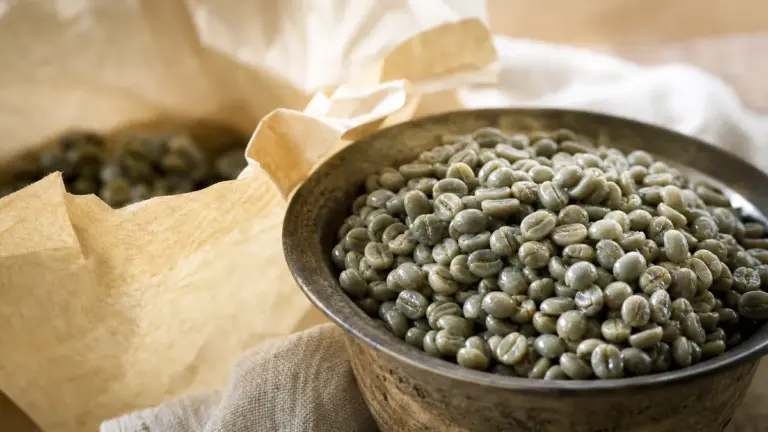
The rules define that stage as coffee seeds dried during post-harvest processing and free of all fruit-wall layers. After that point, additions are prohibited, including exposure to flavourings, aromatic substances, liquids and powders.
In practical terms, co-fermentation or infusion before that boundary is not excluded by this provision; flavouring dried, hulled green coffee afterwards remains prohibited. It is more precise to use the rules’ definition than simply say “before drying” or “before roasting”.
The provision is broad rather than a named approval list for fruit, herbs, yeasts or koji-based treatments. Competitors should confirm a proposed process with the organiser rather than assume every ingredient or preparation is automatically acceptable.
There is also a historical nuance. Although the revised wording is often described as lifting a blanket ban, the official 2024 change summary called it a clarification with no formal difference to existing practice. The verified point is the written boundary from 2024 onwards, not an assumption about every earlier enforcement decision.
These are competition eligibility rules. They are neither a retail labelling scheme nor a general endorsement of a processing method.
FAQ
Does a strawberry tasting note mean strawberries were added?
No, the tasting note alone does not establish that strawberries were added. Sensory descriptions identify resemblances in aroma and flavour, not necessarily ingredients. Check the process description separately. If it does not distinguish tasting notes from additions, ask the roaster for a written explanation rather than drawing a conclusion from the flavour name.
Can you identify an undisclosed infusion by taste alone?
Taste alone cannot establish how a commercial coffee was processed. Aroma-transfer experiments demonstrate one possible mechanism, but they do not provide a sensory test that identifies every infusion. An unusually literal fruit character is a reason to ask questions, not proof of an undisclosed ingredient. Process records are more useful than certainty based on intensity.
Is experimental coffee a better starting point for learning about processing?
Our recommendation is to establish a conventional reference point first, then compare an experimental lot with a clearly documented treatment. That makes it easier to ask focused questions about what you notice. Read Washed vs Natural vs Honey for the baseline distinctions, then judge the experimental coffee on both your enjoyment and the clarity of its disclosure.
Where to go next
Read Coffee Processing Methods for the wider framework, then Washed vs Natural vs Honey to establish the main comparisons. Anaerobic Fermentation is the next read for oxygen management, while Carbonic Maceration explains why that particular technique deserves its own description.
Sources
-
Federal University of Lavras and collaborating institutions: Jimenez et al., Influence of anaerobic fermentation and yeast inoculation on the viability, chemical composition, and quality of coffee, Food Bioscience, volume 51, 2023. Full paper retrieved from Embrapa’s repository.
https://www.alice.cnptia.embrapa.br/alice/bitstream/doc/1148954/1/Influence-of-anaerobic-fermentation-and-yeast-inoculation-on-the-viability.pdf -
Federal University of Lavras and collaborating institutions: Palumbo et al., Impact of different fermentation times on the microbiological, chemical, and sensorial profile of coffees processed by self-induced anaerobiosis fermentation, Brazilian Journal of Microbiology, 2024.
https://pmc.ncbi.nlm.nih.gov/articles/PMC11405557/ -
Velvet Specialty Coffee Roasters: CHIROSO P-16 by Wilton Benitez, undated process description, retrieved November 2026. Used as a direct importer’s account, not independent experimental validation.
https://www.cafevelvet.info/products/chiroso-wilton-benitez -
CIRAD and collaborating researchers: Hadj Salem et al., Transfer kinetics of labeled aroma compounds from liquid media into coffee beans during simulated wet processing conditions, Food Chemistry, volume 322, 2020.
https://www.sciencedirect.com/science/article/pii/S0308814620306415 -
Universidad de los Andes, Cenicafé and collaborating institutions: Madrid-Restrepo et al., Metagenomic, metabolomic, and sensorial characteristics of fermented Coffea arabica L. var. Castillo beans inoculated with microbial starter cultures, mSystems, published online 2025, January 2026 issue.
https://pmc.ncbi.nlm.nih.gov/articles/PMC12817937 -
World Coffee Research: Sensory Lexicon, version 2.0, 2017, and accompanying resource page.
https://worldcoffeeresearch.org/resources/sensory-lexicon -
World Coffee Championships: World Barista Championship Official Rules and Regulations, 2024, 2025 and 2026 editions, section 3.1.C.
2024: https://www.anacafe.org/uploads/file/555f562186e1426dab8bbcb211bc5b92/2024-WorldBaristaChampionship-RulesandRegulations.pdf
2025: https://nzsca.org/wp-content/uploads/2025/04/2025WorldBaristaChampionshipOfficialRulesandRegulations-1.pdf
2026: https://wcc.coffee/s/2026-World-Barista-Championship-Official-Rules-and-Regulations.pdf -
World Coffee Championships: 2024 WBC Summary of Rule Changes, 2024.
This article was researched using primary fermentation studies, World Coffee Research’s sensory resource, published competition rules and an explicitly attributed commercial processing account; no first-hand testing was undertaken.
Last checked: November 2026