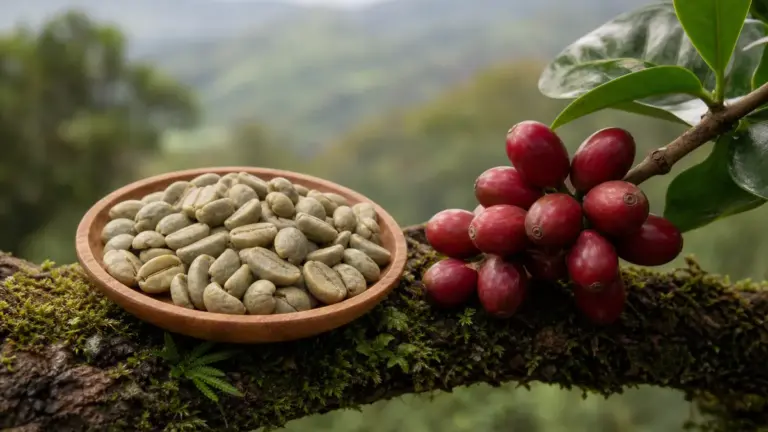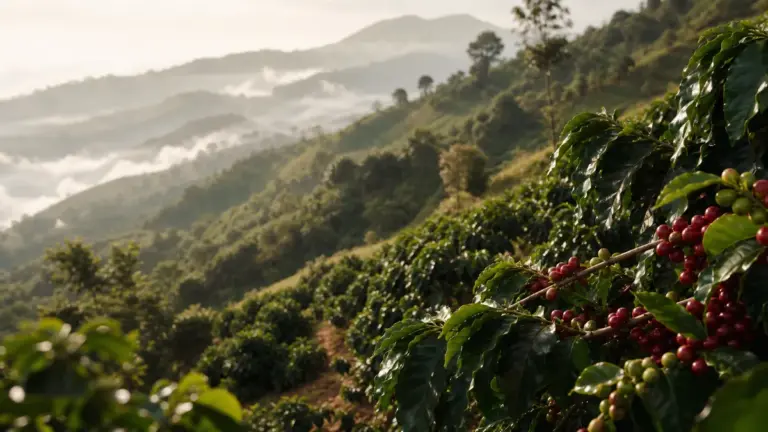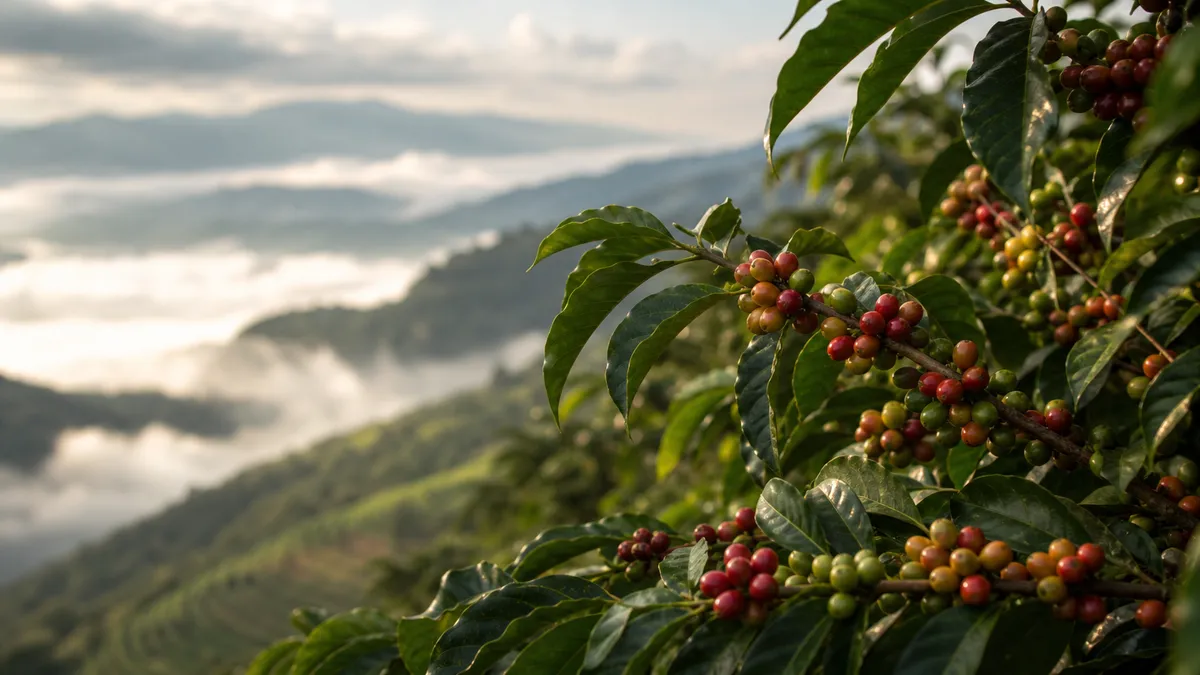
Peruvian coffee often combines chocolate and nut flavours with caramel-like sweetness, while more expressive lots bring citrus, stone fruit and floral aromas. Its defining story is highland arabica grown largely by smallholders, with organic production and producer co-operatives playing important roles.
In short
- Start with the producer, processing method and tasting notes, rather than assuming every Peruvian coffee tastes alike.
- A common growing band is 1,000 to 1,800 metres above sea level, but this is not the country’s full altitude range.
- Look for Cajamarca, Junín and Cusco, alongside Amazonas, San Martín, Pasco and Puno.
- Organic and Fairtrade are different certifications: neither is a flavour grade, and one does not automatically include the other.
- Washed coffee is a useful starting point for exploring the origin, particularly when the bag identifies a farm or co-operative.
What does Peruvian coffee taste like?
Chocolate, nuts, sweetness and fruit are useful starting points, not a national recipe. PROMPERÚ, Peru’s export and tourism promotion agency, identifies floral, sweet, chocolate, nut, spice and acidity attributes in its sensory mapping of the country’s coffees.
For a first purchase, my recommendation is a washed lot whose description mentions chocolate, caramel and citrus. That gives you an approachable reference point before exploring coffees described as floral, tropical or intensely fruity.
Read those descriptors as comparisons. “Chocolate” describes a resemblance in flavour, not an added ingredient; “acidity” describes the bright, lively impression that might remind you of fruit. Neither tells you whether you will enjoy the coffee without considering the rest of its description.
Avoid reducing Peru to “mild coffee”. That label may help someone seeking an undemanding everyday drink, but it gives little guidance to a reader choosing between different farms, varieties and processes.
To place the country within its wider growing area, start with our South American coffee guide. Use the country name to begin your search, then let the individual lot narrow it.
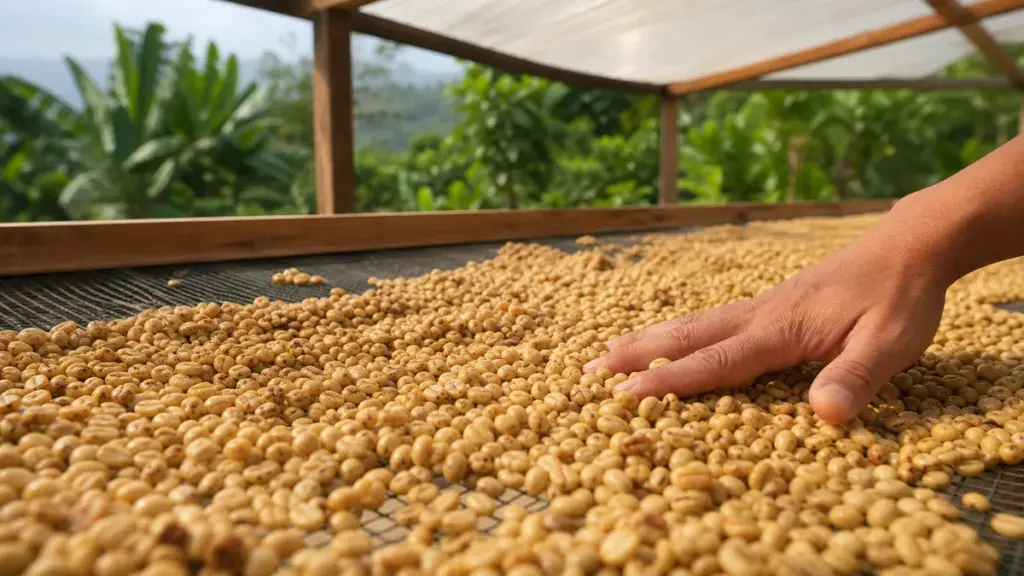
Peru coffee: origin fact panel
| Feature | What to know |
|---|---|
| Main species | Predominantly Coffea arabica, usually called arabica. |
| Altitude | A common growing band is 1,000 to 1,800 metres above sea level, according to USDA’s 2025 country report. Individual growing areas extend outside it. |
| Main varieties and groups | Typica, Caturra, Bourbon, Pache and Catimor-group coffees. This is not a ranking by current planted area. |
| Processing | Washed processing is an established reference: fruit pulp is removed, the remaining sticky layer is broken down and washed away, and the coffee is dried. |
| Harvest | USDA identifies April to July as the main harvest period. Treat this as a national guide, not a fixed calendar for every farm. |
| Cup profile | Chocolate, nuts and sweetness, with fruit, floral aromas and differing levels of acidity according to the lot. |
The panel draws on USDA, Solidaridad’s Peruvian production guide and PROMPERÚ’s sensory work. It deliberately avoids assigning one flavour, altitude or picking date to every producer.
The growing regions to recognise
Peru’s coffee areas extend through northern, central and southern parts of the country. For buyers, the most useful distinction is between an administrative region, such as Junín, and a more specific producing area, such as Chanchamayo.
| Region | Names and locations worth recognising |
|---|---|
| Cajamarca | Northern Peru, particularly the producing provinces of Jaén and San Ignacio. |
| Junín | Central Peru, including Chanchamayo and Satipo. |
| Cusco | South-eastern Peru, with La Convención an important producing province. |
| Amazonas and San Martín | Separate northern regions, not interchangeable names for the Amazon basin. |
| Pasco | Central Peru, including Oxapampa and Villa Rica. Villa Rica is not in Junín. |
| Puno and other areas | Puno contributes southern production; Huánuco, Ayacucho and Piura also belong on the coffee map. |
Cajamarca, Junín and Cusco
These are useful names to learn first because they lead towards more specific origins. A Cajamarca bag might identify Jaén or San Ignacio; a Junín coffee might name Chanchamayo or Satipo. Cusco should prompt you to look beyond the famous city to the producing province and farm.
Do not turn that geography into a rigid tasting chart. For shopping, I would use the region to organise comparisons, then check whether the coffees also share a process and broadly similar roast description.
Look beyond the familiar names
Villa Rica is especially worth placing correctly: it belongs to Pasco, despite its frequent appearance alongside discussions of the central coffee-growing zone. Amazonas, San Martín and Puno deserve attention in their own right rather than being treated as background to better-known origins.
A useful tasting project is to compare lots from different Peruvian regions before making an international comparison. Afterwards, our Colombian coffee guide offers another country-level reference without requiring every difference to be explained by a border.
Smallholders, shade and the journey off the farm
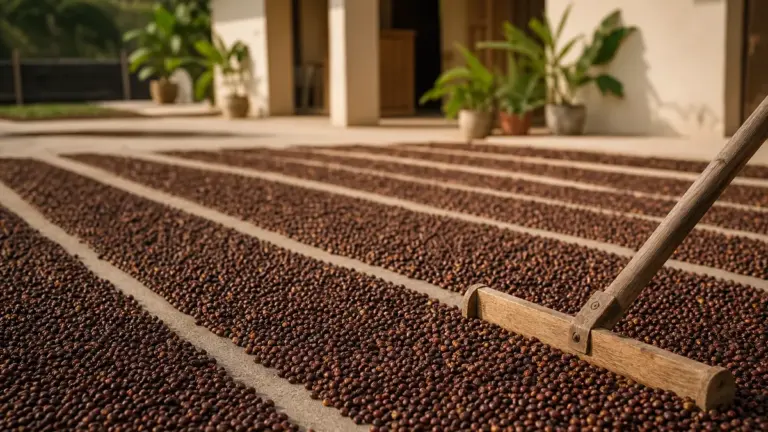
USDA’s 2025 report describes most Peruvian coffee farms as smaller than 5 hectares, with shade-growing, hand-picking and sun-drying common practices. Smallholder here means a farmer working a relatively small holding, not a particular certification or quality category.
The collective organisation of those farmers matters. A co-operative can bring together coffee that would otherwise be offered in much smaller quantities, while providing a recognisable producer organisation for buyers to trace.
La Florida, a Chanchamayo co-operative, describes member holdings of 2 to 4 hectares, shaded farms and shared processing and collection facilities. This is a concrete example, not a template that every Peruvian producer follows.
For the reader, the practical lesson is to ask what a producer name represents. Is the bag a single farm’s coffee, a small separated lot, or a blend of coffees from co-operative members? None is automatically preferable. They answer different questions about traceability, consistency and whose work the coffee represents.
Shade-growing also needs a specific explanation. A reference to trees on a farm is useful information, but it should not be expanded into an unsupported claim about every environmental impact of the finished coffee.
Organic and Fairtrade coffee from Peru
Organic is a production standard
Peru has a substantial certified-organic coffee sector. USDA’s 2025 report identified approximately 90,000 hectares of certified-organic coffee cultivation, a dated estimate rather than a live total.
Organic farming restricts agricultural inputs and places emphasis on soil management. It does not mean that a farmer simply leaves the crop alone. The Soil Association describes practices including building fertility with compost and tightly restricting pesticide use.
For UK buyers, distinguish certification from attractive wording about “natural” farming. DEFRA’s guidance requires organic claims to be supported by inspection and certification, and organic labels must carry the relevant control-body code.
Organic certification is not a tasting score. Choose it when its production requirements matter to you, then assess the coffee’s flavour description and traceability separately.
Fairtrade addresses different questions
Fairtrade’s coffee standard applies to small producer organisations and traders. Its trading requirements include a minimum-price mechanism and a separate Fairtrade Premium, alongside other obligations. These are distinct from organic production requirements.
A coffee can carry both certifications, but you should check for both rather than infer one from the other. Smithsonian’s listing for CAC Pangoa in Junín provides a specific example of an organisation with organic and fair-trade certifications, alongside Bird Friendly certification.
The useful buying question is therefore not simply “Is Peruvian coffee ethical?” Ask which organisation produced this coffee, which certification covers it and what the seller can document. A national reputation cannot substitute for information about the product in your hand.
Why altitude and varieties need careful reading
Altitude is context, not a quality score
Higher elevation often brings cooler growing conditions. Slower fruit development is one mechanism associated with differences in bean composition and cup quality, but altitude works alongside shade, plant nutrition, variety and other growing conditions.
Peer-reviewed field research in Ethiopia has examined these interacting factors. It supports taking altitude seriously, not treating it as a universal rule that the highest farm must produce the best coffee. Those studies are also not direct measurements of Peruvian farms.
World Coffee Research makes a related distinction in its variety catalogue: suitable altitude depends partly on latitude. For a buyer, the sensible response is to read an altitude figure alongside the location, variety and processing details, rather than use it as a league table.
Variety names are not equally precise
Typica, Caturra, Bourbon and Pache are arabica variety names you may encounter. World Coffee Research identifies Pache as a natural dwarf mutation of Typica, illustrating how a familiar label can carry meaningful genetic information.
“Catimor” needs more care because it names a group rather than one uniformly identified variety. World Coffee Research’s 2024 seed-sector report documents the importance of Catimor-group material in Peru and difficulties identifying exactly which varieties some farmers grow.
Sources also disagree about national variety proportions. USDA’s 2025 report repeats a Typica-heavy breakdown, whereas WCR’s specialist seed-sector investigation describes extensive Catimor-group planting. This article follows WCR’s more specific treatment of variety identity and does not publish a supposedly definitive national percentage.
That uncertainty is a reason to ask better questions, not to dismiss the coffee. Prefer a clearly documented lot over an impressive variety claim that the seller cannot explain.
Choosing a Peruvian coffee in the UK
Use this order when reading a bag or roaster’s listing:
- Identify the producer. Look for a farm, co-operative or clearly described producer group.
- Check the process. Washed is a sensible reference point for your first comparison.
- Read the tasting description. Choose familiar chocolate-led notes or a more fruit-focused description according to your preference.
- Separate certification from flavour. Verify organic and Fairtrade claims individually.
- Ask what is missing. A short, clear answer about the lot is more useful than additional adjectives.
For a shared workplace, my preference would be to begin with a chocolate-led washed coffee and collect feedback before exploring more unusual profiles. For a personal tasting, I would choose contrasting Peruvian lots and keep the preparation the same, so the comparison stays useful.
If you are exploring neighbouring origins, use our Ecuadorian coffee guide as a separate reference rather than expecting it to provide a shortcut to Peru’s character.
FAQ
Does single-origin Peru mean the coffee comes from one farm?
No, the country name alone does not establish farm-level traceability. Ask whether the coffee comes from a named farm, a separated producer lot or a co-operative collection. Each can be a worthwhile choice, but “Peru” by itself does not answer that question. Look for an explicit description of what has been combined.
Does a co-operative coffee mean lower quality?
No, the organisational structure is not a quality grade. A co-operative name tells you something about how producers work together, not whether you will enjoy a particular coffee. My recommendation is to judge the actual lot description and the clarity of its sourcing information rather than prefer or reject it because of the organisation behind it.
Which Peruvian region should I try first?
Choose the best-described lot rather than selecting a region in isolation. For a first comparison, I would take a washed coffee with clear chocolate and citrus notes, then try another Peruvian lot with a different description. Keep a note of the producer and region so that the result helps you choose your next bag.
Where to go next
Read South America through our regional overview to place Peru within the wider growing area. Continue with Colombia through its country guide, or Bolivia through our neighbouring-origin guide, to build a comparison based on individual coffees rather than national stereotypes.
Sources
-
USDA Foreign Agricultural Service, Coffee Annual: Peru, report PE2025-0018, 21 May 2025. Used for growing conditions, farm size, harvest and the dated organic-area estimate.
https://apps.fas.usda.gov/newgainapi/api/Report/DownloadReportByFileName?fileName=Coffee+Annual_Lima_Peru_PE2025-0018.pdf -
PROMPERÚ, Regiones cafetaleras, undated, retrieved November 2026. Used for the broad sensory attributes, not the page’s incorrectly populated numerical fields.
https://peru.info/cafesdelperu/regiones-cafetaleras -
PROMPERÚ, Aromas y sabores: El mapa sensorial del café peruano, 2019. Used for regional geography and the limits of generalising from sensory profiles.
https://repositorio.promperu.gob.pe/server/api/core/bitstreams/dd83e3e5-1b30-4842-97f8-37ee900f57e3/content -
PROMPERÚ, ¿Cuáles son las principales rutas cafeteras del Perú?, undated, retrieved November 2026. Used for producing-area names and Villa Rica’s location.
https://www.peru.travel/es/inspirate/cuales-son-las-principales-rutas-cafeteras-del-peru -
Solidaridad, Café 2.0 climáticamente inteligente, November 2016. Used for established varieties, harvesting and washed processing.
https://camcafeperu.com.pe/admin/recursos/publicaciones/Cafe-2.0-climaticamente-inteligente.pdf -
Cooperativa La Florida, Florida Cooperative, undated, retrieved November 2026. Used as a producer’s account of its holdings, shade and shared facilities.
https://laflorida.org.pe/en/la_florida -
World Coffee Research, Quality Assurance in the Coffee Seed Sector, 2024, Peru section.
https://worldcoffeeresearch.org/index.php/actions/wcr/downloads/download?assetUid=42f76c84-0ef7-415d-bbd2-0ff49d8536da -
World Coffee Research, Arabica Coffee Varieties: Pache, online catalogue, undated, retrieved November 2026.
https://varieties.worldcoffeeresearch.org/varieties/pache -
DEFRA, Organic food: labelling and advertising rules, updated 20 August 2025.
https://www.gov.uk/guidance/organic-food-labelling-rules -
Soil Association, Why organic?, undated, retrieved November 2026. Used for input restrictions and soil-management principles only.
https://www.soilassociation.org/what-we-do/championing-organic/why-organic/ -
Fairtrade International, Fairtrade Standard for Coffee, version 15.07.2021_v2.9, retrieved November 2026.
https://www.fairtrade.net/content/dam/fairtrade/fairtrade-international/standards/small-scale-producer/coffee/Coffee_SPO_EN.pdf -
Smithsonian National Zoo and Conservation Biology Institute, CAC Pangoa, undated, retrieved November 2026.
https://www.nationalzoo.si.edu/migratory-birds/certified-coffee-farms/cac-pangoa -
Tolessa, K., D’heer, J., Duchateau, L. and Boeckx, P., Influence of growing altitude, shade and harvest period on quality and biochemical composition of Ethiopian specialty coffee, Journal of the Science of Food and Agriculture, 2017.
https://scijournals.onlinelibrary.wiley.com/doi/10.1002/jsfa.8114 -
Tassew, A. A. and colleagues, Influence of location, elevation gradients, processing methods, and soil quality on the physical and cup quality of coffee in the Kafa Biosphere Reserve of SW Ethiopia, Heliyon, 2021.
https://biblio.iita.org/documents/U21ArtTassewInfluenceInthomDev.pdf-efded642fd5adbbb8950dbc22f4a89be.pdf
Researched through retrieved official origin publications, specialist variety references, certification guidance, a producer account and peer-reviewed agronomy, without first-hand tasting or farm visits.
Last checked: November 2026