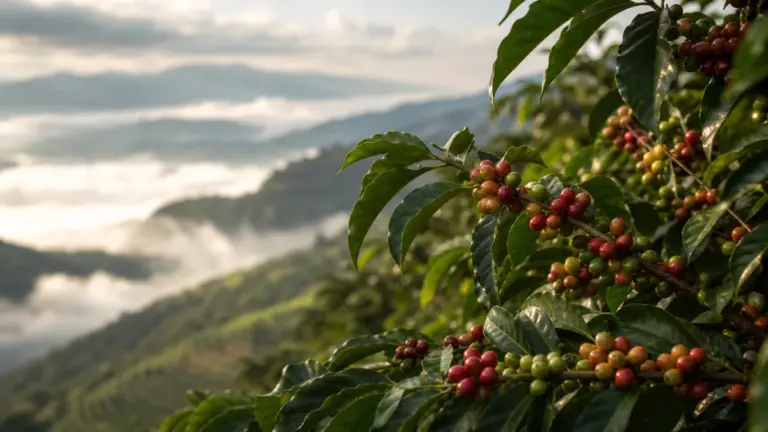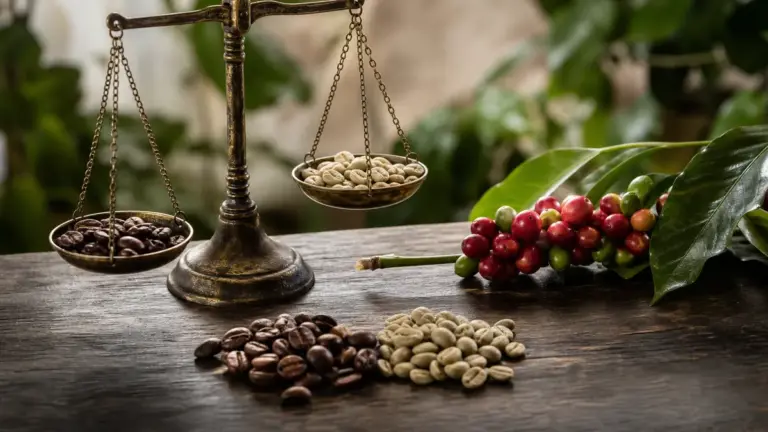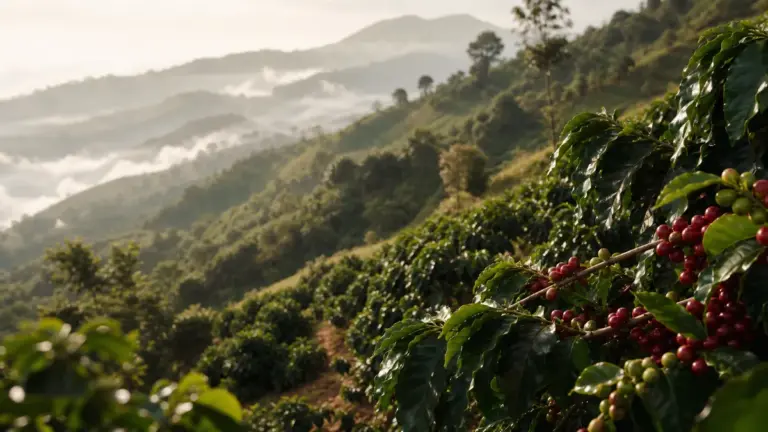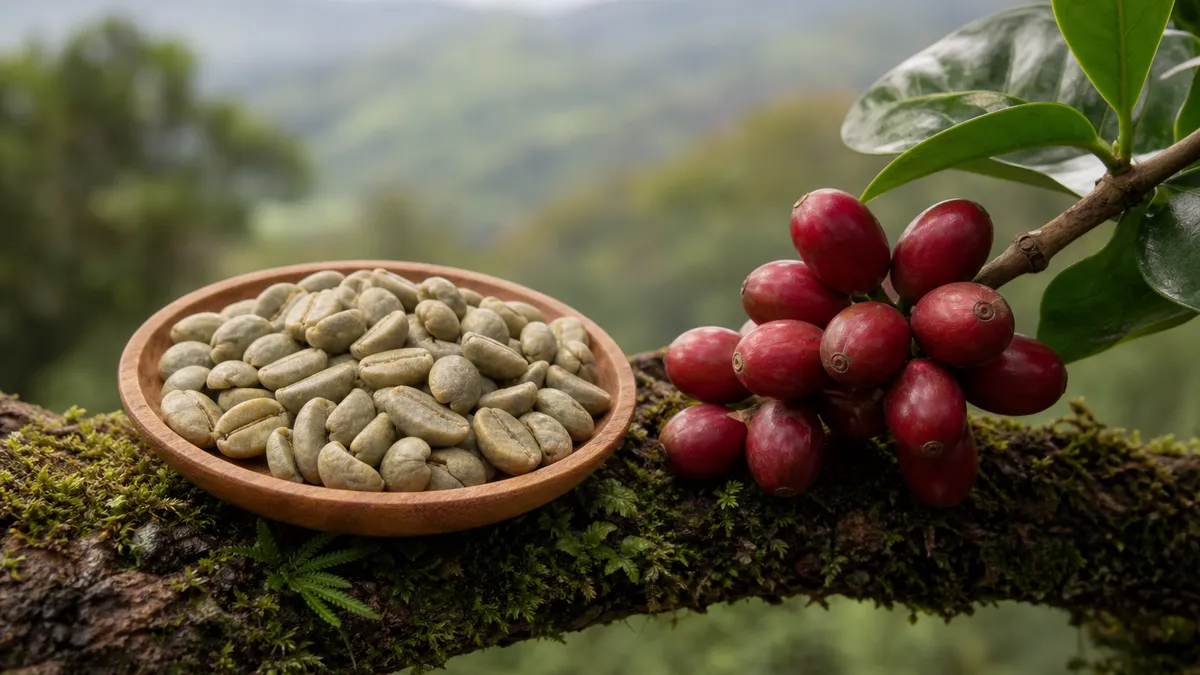
Ecuadorian specialty coffee can be sweet, floral and brightly fruity, with citrus, yellow-fruit and brown-sugar notes, although there is no single national flavour. Its highland arabica, including coffees sold as Sidra and Typica Mejorado, should be distinguished from the country’s coastal and Amazonian robusta production.
In short
- Choose by producer, variety and processing method, rather than expecting every Ecuadorian coffee to taste alike.
- Ecuador grows both Coffea arabica and Coffea canephora, traded as robusta.
- Documented specialty arabica examples extend from 1,160 metres to 2,300 metres above sea level. These are examples, not the country’s absolute growing limits.
- Washed, natural and honey coffees are all produced, alongside experimental fermentation styles.
- Sidra’s commonly repeated Bourbon × Typica parentage is not established. Recent genetic evidence places confirmed material within the Core Ethiopia group.
What does Ecuadorian coffee taste like?
The most useful starting point is sweetness supported by fruit and floral aromas. Ecuadorian producer profiles describe citrus, yellow and red fruits, flowers and sometimes herbal notes; an importer’s washed Sidra example lists pomegranate, pink grapefruit and brown sugar. Treat these as descriptions of particular coffees, not a promise attached to the country name.
For a first purchase, my recommendation is a traceable washed arabica with a clear flavour description. It gives you a useful reference before exploring more fermentation-led lots. Choose citrus and floral descriptions if you enjoy a fragrant cup, or brown-sugar and caramel descriptions if sweetness matters more to you than an assertively fruity character.
Ecuador’s interest lies in its variation rather than a dependable national signature. The South American coffee guide provides the wider context; here, the more useful questions are which farm produced the coffee, what was planted and how the cherries were processed.
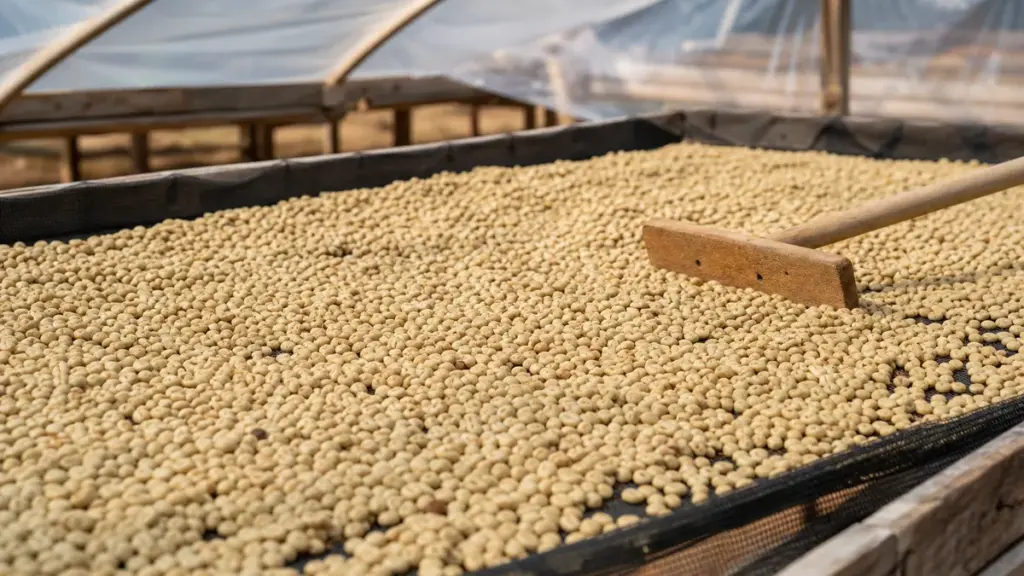
Ecuador coffee fact panel
| Feature | What to know |
|---|---|
| Altitude | Documented specialty arabica examples range from 1,160 metres at a Nanegal farm to southern growing areas reported at 1,700 to 2,300 metres. Neither figure defines a nationwide boundary. |
| Main varieties and names | Established arabica types include Typica, Bourbon and Caturra. Specialty listings also feature Sidra, Typica Mejorado and Gesha, often written Geisha. This is not a ranking by planted area. |
| Processing | Washed, natural and honey, with selected lots using natural anaerobic and other experimental processes. |
| Harvest months | Timing is local: Fundochamba in Loja reports May to July, while a documented Nanegal Sidra lot gives June to September. Ask for the individual lot’s harvest period. |
| Typical specialty cup | Sweet, floral and fruity, sometimes showing citrus, yellow fruit, red fruit and brown sugar. These are recurring published descriptors, not a national sensory specification. |
Where Ecuadorian coffee grows
Loja
Loja is a strong starting point for exploring Ecuadorian specialty arabica. The official Ecuador Cup of Excellence results for 2021 place washed Typica Mejorado and natural Sidra among the leading coffees from the province. That demonstrates the potential of selected lots, not the average quality of everything grown there.
Look for a locality or farm name alongside Loja. Saraguro, Quilanga and Sozoranga appear in official specialty selections, giving buyers more useful detail than the province alone. If you already enjoy coffees from Peru, a tasting comparison is a useful way to explore Ecuador without assuming that neighbouring origins are interchangeable.
Pichincha
Pichincha is another important specialty area, with documented coffees from Nanegal and Gualea. It is closely associated with the commercial histories of Sidra and Typica Mejorado, although the stories about their introduction require more caution than many bag descriptions suggest.
Do not assume that every notable Pichincha coffee comes from exceptionally high ground. Royal Coffee documented Olger Rogel’s washed Sidra at 1,160 metres in Nanegal, while the 2026 Ecuador Farmer’s Collection lists a Gualea Sidra at 1,800 metres. Both illustrate why a province is too broad to describe one growing environment.
Zamora Chinchipe and other mainland areas
Zamora Chinchipe belongs firmly in the specialty picture. Official selections include coffees from Zumba and Chito, while research on coffee handling has worked with producers and collection centres around Palanda. These names are useful details to look for on a traceable lot.
Other areas deserve attention too. Imbabura appears in the 2026 Farmer’s Collection, and Chimborazo’s Lugmapata appears in the 2021 Cup of Excellence results. El Oro and Manabí also form part of Ecuador’s arabica-growing geography. The country’s coffee story is broader than its best-known specialist farms.
Galápagos
Ecuador also has a small island coffee sector, including San Cristóbal and Santa Cruz. The agriculture ministry documents arabica varieties such as Bourbon, Typica and Caturra in the islands, alongside facilities for processing their harvests. Galápagos coffee is therefore a genuine origin, not simply an evocative name.
For buying purposes, ask which island and producer supplied the beans. I would treat the island name as an invitation to investigate the coffee, not as a substitute for information about its processing and flavour.
Highland arabica and lowland robusta are different stories
Ecuador’s specialty reputation should not obscure its robusta sector. National agricultural information identifies both species, while INIAP research documents robusta cultivation and improvement work in the coastal region and Amazonia.
This is a different production setting from the highland arabica farms that attract much of the attention from specialty buyers. Research on Ecuadorian Coffea canephora also finds substantial genetic diversity, so robusta should not be treated as one uniform planting material.
The practical lesson is simple: check the species. “Ecuadorian coffee” alone does not tell you whether the bag contains arabica, robusta or a blend. For regional comparisons, read Colombia separately rather than using a neighbouring country’s reputation to fill gaps in an Ecuadorian coffee’s description.
What altitude can and cannot tell you
Altitude matters largely through the growing conditions associated with it. Cooler conditions can slow cherry maturation, affecting the development of compounds involved in flavour and aroma. Field research also shows that altitude interacts with sunlight and local growing conditions, rather than producing a simple improvement with every extra metre.
That makes elevation useful context, not a quality certificate. A high figure cannot tell you whether cherries were harvested well or whether the resulting coffee suits your taste.
My buying rule is to read altitude alongside variety, processing and the roaster’s description. If those details are missing, an impressive elevation should not do all the persuasive work.
Processing changes the expression of the coffee
Ecuador produces washed, natural and honey coffees. In broad terms, natural processing dries the fruit intact, while washed processing removes the fruit covering before the final drying of the parchment-covered seed. Honey processing removes the skin and pulp but retains some or all of the sticky fruit layer, called mucilage, during drying.
Experimental descriptions also appear in official Ecuadorian selections. The 2021 results include natural anaerobic lots, while later selections list carbonic maceration and other named fermentation approaches. These are processing descriptions, not varieties or regions.
For a useful tasting exercise, compare washed and natural coffees from the same producer where available. Keep your brewing method consistent and record what you notice about aroma, sweetness, fruit character and finish. It will not isolate processing perfectly, but it is more informative than comparing unrelated coffees and attributing every difference to the country.
Sidra and Typica Mejorado: names need careful handling
Sidra’s genetic background
Sidra, also written Sydra or Bourbon Sidra, has often been presented as a Bourbon × Typica cross. Older importer material repeats that explanation, but it should not be treated as settled parentage.
A peer-reviewed study published on 14 July 2026 used DNA fingerprinting by RD2 Vision to investigate commercially acquired planting material at a southern Ecuadorian farm. Two plants identified as Sidra belonged to the Core Ethiopia genetic group, supporting an Ethiopian landrace-derived origin rather than the commonly repeated cross. A landrace is a locally developed cultivated population, rather than a pedigree established through a documented breeding cross.
The study was limited to one farm and did not establish the identity of every coffee sold as Sidra. Its findings support caution, not a replacement claim that every Sidra-labelled tree has an identical genetic identity.
Typica Mejorado and the research-station story
Typica Mejorado, also called Typica Mejorada or simply Mejorado, should not automatically be understood as ordinary Typica with better performance. Ecuadorian producer Hacienda La Florida reports Bourbon × Ethiopian landrace ancestry and connects its history with former Nestlé research fields in Pichincha during the 1990s. Those are attributed producer accounts, not a pedigree demonstrated by the 2026 Sidra study, which did not test Mejorado.
The wider research-station story remains incompletely documented. Olger Rogel is a documented Sidra grower in Nanegal, but the retrieved primary material does not establish the frequently repeated account of him as the technician who first disseminated both varieties. Genetics, oral history and documented distribution should remain separate.
For the reader, the useful distinction is that confirmed Sidra’s Core Ethiopia placement and reported Mejorado hybrid ancestry are not the same finding. Neither name guarantees a particular cup.
How to choose Ecuadorian coffee in the UK
Use this checklist rather than chasing a variety name alone:
- Find the producer or producer group. Prefer a description that goes beyond “Ecuador”.
- Check the species and variety. Keep names such as Sidra and Mejorado separate from proven genetic certification.
- Read the processing description. Ask the roaster to explain unfamiliar terminology.
- Choose a flavour direction you actually enjoy. Floral and citrus-led is not automatically better than rounded and sweet.
- Ask about harvest and roast dates separately. Use the local harvest examples above as context, not a rigid national calendar.
My recommendation for exploring Ecuadorian coffee is to start with a well-described washed lot, then try a contrasting process or variety. That gives you a personal reference point and lets the producer’s work, rather than the origin’s reputation, guide the next purchase.
FAQ
Does “Bourbon Sidra” prove that the coffee has Bourbon parentage?
No, the commercial name is not proof of parentage. Recent genetic work places confirmed Sidra material within the Core Ethiopia group, whereas older trade descriptions commonly call it a Bourbon × Typica cross. Read “Bourbon Sidra” as the supplier’s variety designation unless supporting genetic evidence is provided.
Does an Ecuadorian competition result describe the whole origin?
No, it describes the selected coffee evaluated in that competition. Official results identify particular farms, varieties and processes, rather than providing a national average. They are useful evidence of what individual producers can achieve, but a competition association should not replace information about the actual lot you are buying.
Is Ecuadorian coffee automatically organic?
No, do not infer organic certification from the origin, farm size or island name. Certification is a separate detail to check with the seller. As a concrete example, Royal Coffee’s documented Nanegal Sidra listing identifies its certification status as conventional, despite its detailed farm traceability and specialty positioning.
Where to go next
Read South America to place Ecuador within the wider region, then Brazil to broaden your origin comparisons. Bolivia is another useful next read for continuing your exploration of South American coffee without reducing the continent to one flavour profile.
Sources
-
Ecuador Ministry of Agriculture, Café, undated. National species and producing provinces.
https://trazabilidad.agricultura.gob.ec/?p=408 -
Import Promotion Desk, IPD at World of Coffee 2024, 2024. Ecuador overview and producer profiles.
https://www.importpromotiondesk.de/fileadmin/Messebroschueren/240627_IPD_at_World_of_Coffee_2024.pdf -
Royal Coffee, Ecuador Farmgate Pichincha Olger Rogel Washed Sidra, undated lot record. Altitude, harvest, processing, tasting notes and producer account.
https://royalcoffee.com/product/3427097000016471073/ -
Alliance for Coffee Excellence, Ecuador 2021, 2021. Official competition results.
https://allianceforcoffeeexcellence.org/ecuador-2021/ -
Alliance for Coffee Excellence and Qima Coffee, Ecuador Farmer’s Collection, 2026. Official selection records.
https://allianceforcoffeeexcellence.org/ecuador-farmers-collection-2026/ -
GAD Parroquial de Fundochamba, Agrícola, undated. Local harvest calendar.
https://fundochamba.gob.ec/agricola/ -
Ecuador Ministry of Agriculture, Productores de Galápagos reciben infraestructura para procesar café, undated. Island production and arabica varieties.
https://www.agricultura.gob.ec/productores-de-galapagos-reciben-infraestructura-para-procesar-cafe/ -
INIAP, INIAP fortalece procesos de investigación y validación de café robusta, undated. Coastal and Amazonian research locations.
https://www.iniap.gob.ec/iniap-fortalece-procesos-de-investigacion-y-validacion-de-cafe-robusta-coffea-canephora-pierre/ -
Loor Solórzano and colleagues, INIAP and CIRAD, Revealing the Diversity of Introduced Coffea canephora Germplasm in Ecuador: Towards a National Strategy to Improve Robusta, 2017.
https://onlinelibrary.wiley.com/doi/10.1155/2017/1248954 -
Agronomy, Association of Altitude and Solar Radiation to Understand Coffee Quality, volume 12, article 1885, 2022. Field research on interacting growing conditions.
https://www.mdpi.com/2073-4395/12/8/1885 -
López Quezada and colleagues, Factors that determine the quality of coffee (Coffea arabica L.) in southern Ecuador: A case study, 2021.
https://portal.amelica.org/ameli/journal/646/6462829008/html/ -
CBI / Agri-Logic, Value Chain Analysis for the Coffee Sector in Rwanda, 2018, Annex VII. Processing definitions only.
https://www.cbi.eu/sites/default/files/2018_value_chain_analysis_for_the_coffee_sector_in_rwanda.pdf -
Tapia-Armijos and colleagues, Universidad Técnica Particular de Loja, What you plant may not be what you bought: morphological and genetic discordance in specialty Coffea arabica L. cultivars from Ecuador, Frontiers in Plant Science, volume 17, article 1868034, 14 July 2026.
https://www.frontiersin.org/journals/plant-science/articles/10.3389/fpls.2026.1868034/full -
Hacienda La Florida, Typica Mejorado: Ecuador’s Specialty Coffee Variety, 21 June 2026. Producer account, not independent pedigree confirmation.
https://haciendalaflorida.com/en/blog/typica-mejorado/ -
Christophe Montagnon / RD2 Vision, public commentary sharing a discussion of Sidra and Typica Mejorado’s undocumented origins, 2026. Used to assess uncertainty, not as a peer-reviewed pedigree.
https://www.linkedin.com/posts/christophe-montagnon-607a9853_what-i-find-fascinating-with-many-of-the-activity-7451694205908791296-D6qX
Research combined official agricultural information, competition records, published research and explicitly attributed producer and importer accounts; no first-hand tasting is claimed.
Last checked: November 2026