Brazilian coffee is often sweet and full-bodied, with chocolate, nut and caramel flavours and gentle acidity, making it a useful starting point for espresso and milk drinks. Brazil is also the world’s largest coffee producer, but its output includes both arabica and conilon or robusta, from highly mechanised estates to small family farms.
In short
- For a familiar chocolate-and-nut profile, look for a Brazilian arabica with those tasting notes rather than relying on the country name alone.
- Natural processing dries the whole coffee cherry; pulped natural removes the skin before drying with sticky mucilage still attached.
- Minas Gerais is the main arabica-producing state. Espírito Santo and Bahia are particularly important for conilon and robusta.
- A machine-harvested coffee is not automatically inferior: ripeness, sorting and drying also determine quality.
- Harvest generally falls between April and September, with conilon starting before arabica, although individual regions and seasons vary.
Brazilian coffee at a glance
These are regional reference points, not fixed limits for every Brazilian farm.
| Feature | Origin fact panel |
|---|---|
| Altitude | Cerrado Mineiro arabica: 800 to 1,300 m; Mantiqueira de Minas: 900 to 1,500 m; Espírito Santo conilon is commonly grown at lower elevations, up to about 600 m |
| Main varieties and planting material | Arabica includes Mundo Novo, Catuaí and Bourbon; canephora production includes conilon and robusta planting material, including selected clones and crosses |
| Main processing methods | Natural and pulped natural; washed coffees are also produced |
| Harvest months | Broadly April to September; conilon commonly begins in April and arabica in May |
| Typical cup profile | Chocolate, nuts and caramel, moderate to full body and gentle citrus acidity in familiar arabica profiles; individual lots can differ considerably |
The altitude and flavour descriptions come from regional producer and Brazilian government publications. The harvest window is supported by USDA reporting, while World Coffee Research and Embrapa provide the variety and processing references listed below.
What does Brazilian coffee taste like?
The familiar Brazilian arabica profile is rounded rather than sharply acidic: think cocoa, roasted nuts and caramel, with enough body to give the drink substance. Cerrado Mineiro’s producer organisation describes its regional coffees in similar terms, including delicate citrus acidity and moderate to full body.
Here, body means the weight and texture of the drink in your mouth. Acidity means its bright, fruit-like character, not necessarily an unpleasant sour taste.
That profile helps explain Brazil’s role in espresso blends. A chocolatey, substantial coffee can provide the blend’s foundation, while another component contributes brighter fruit or floral aromas. It can also be enjoyable on its own, so “blend component” should not be read as a lower quality category.
Brazil is not uniformly low in acidity, however. Mountain-grown coffees from Espírito Santo can have brighter acidity and fruit characteristics, and processing creates further differences. The tasting notes on the particular bag are more useful than assuming every Brazilian coffee tastes alike.
For the wider regional context, start with South American coffee.
How much coffee does Brazil produce?
USDA’s July 2026 forecast for the 2026/27 marketing year put Brazilian production at 71.9 million 60 kg bags, against a world total of 189.667 million bags. That makes Brazil’s forecast share approximately 37.9%, calculated as 71.9 ÷ 189.667 × 100.
These are forecasts, not a completed harvest total. Brazil’s USDA marketing year runs from July to June, and the figures should not be mixed casually with calendar-year statistics or another organisation’s crop estimates.
The same forecast divides Brazilian output into 47.5 million bags of arabica and 24.4 million bags of robusta, the statistical category that includes Brazilian conilon. Brazil is therefore much more than an arabica origin.
Its production also changes between seasons. Arabica trees tend to alternate between heavier and lighter crops, although weather and farm management can strengthen or disrupt that pattern.
The main Brazilian coffee regions
Minas Gerais
Minas Gerais is the centre of Brazilian arabica production. Useful names to recognise include Sul de Minas, Cerrado Mineiro, Mantiqueira de Minas and Matas de Minas.
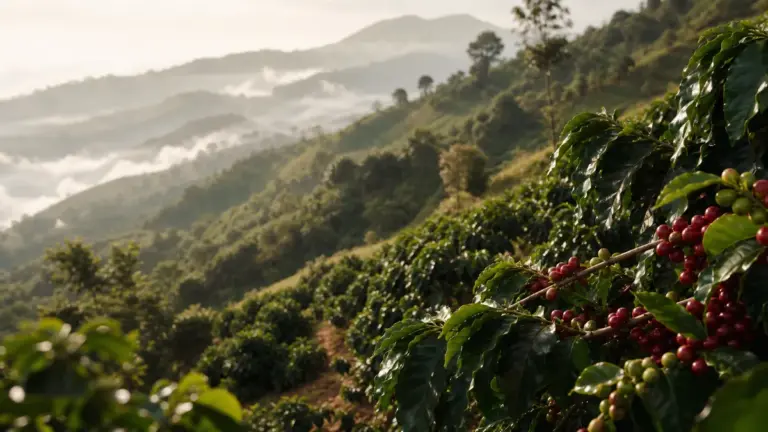
Cerrado Mineiro has clearly differentiated wet summers and dry winters. Its regional description is a helpful reference for the sweet, chocolate-and-nut style many drinkers associate with Brazil. Mantiqueira and Matas de Minas add mountain-growing areas to the picture, rather than another version of a flat mechanised estate.
These names are worth seeking on a bag because “Minas Gerais” alone still covers considerable diversity.
São Paulo
São Paulo is another established arabica-producing state. Alta Mogiana, in its north, is a recognised regional name, with Catuaí, Mundo Novo, Bourbon and Obatã among its cultivated varieties.
For buyers, the useful distinction is between a traceable regional coffee and a broad national description. Neither guarantees that you will enjoy the flavour, but the former gives you more information to compare.
Espírito Santo, Bahia and Rondônia
Espírito Santo is central to Brazilian conilon production, while its mountains also produce arabica. Treating the whole state as a single coffee type misses that distinction.
Bahia grows both arabica and canephora coffees. Its arabica areas include Chapada Diamantina, while irrigated canephora production is an important part of the state’s output.
Rondônia is another significant canephora origin. World Coffee Research documents Brazilian planting material selected from natural crosses between conilon and robusta plants, illustrating why the terminology needs more care than simply calling everything Brazilian arabica.
Mechanised estates and small family farms
Brazil’s reputation for mechanisation has a real basis. Suitable terrain and organised planting allow machinery to carry out harvesting and other field operations at scale.
But mechanisation is not universal. Steep land restricts large harvesters, and Brazilian production also includes smallholder and less mechanised systems. Government descriptions of Mantiqueira de Minas identify a strong small-producer presence, while mountain production in Espírito Santo includes predominantly artisanal harvesting practices.
There is also a middle ground between picking everything by hand and using a large self-propelled harvester. The International Trade Centre describes both hand-held harvesting machines and larger wheeled equipment.
The quality question is what happens to the fruit. Bulk harvesting can collect cherries at different stages of ripeness, making separation important. Modern sorting can divide ripe, unripe and overripe fruit for separate processing.
A useful buying question is therefore “How was this lot harvested and sorted?”, not simply “Was it hand-picked?” Farm size and harvesting equipment tell only part of the story.
Natural and pulped natural processing
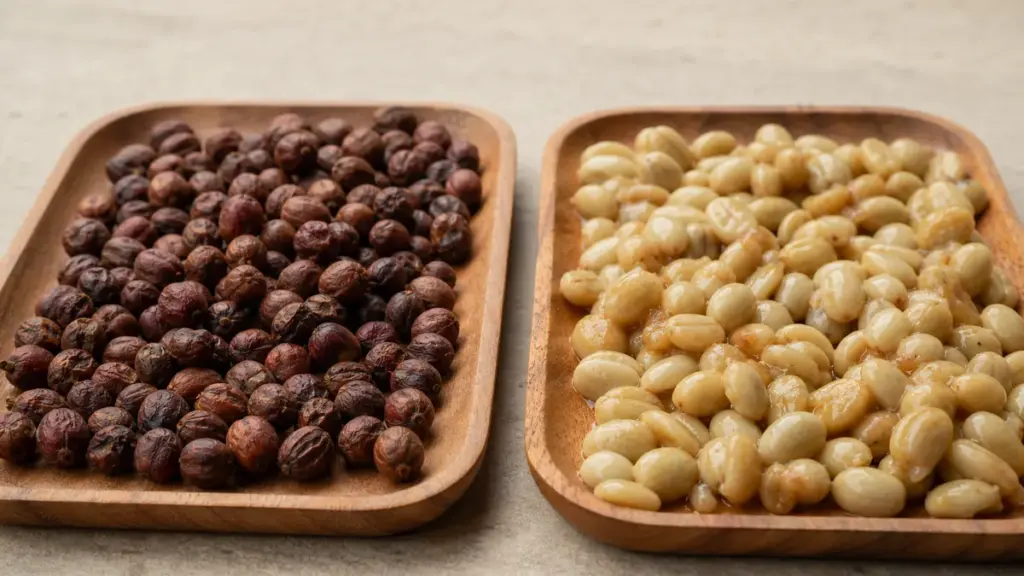
Processing means the steps that turn harvested coffee fruit into dried green beans ready for milling and roasting. Brazil is particularly associated with natural and pulped natural methods.
Natural: drying the whole cherry
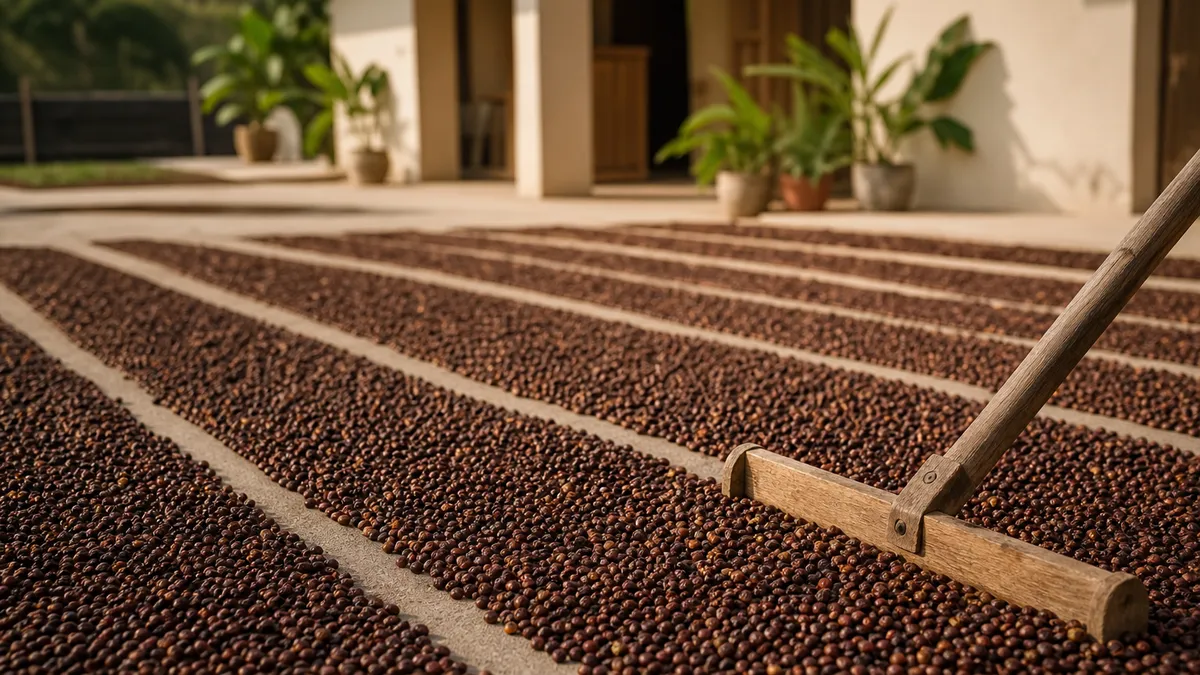
In natural processing, the cherries dry with their skin and flesh intact. The dried outer layers are removed later.
Drying can take place on patios, raised beds or in mechanical dryers, sometimes using a combination. The neat raked lines on a large drying patio are part of active management, not just an attractive pattern: turning helps the coffee dry evenly.
Natural processing can produce sweet, substantial coffees, including fruit-led styles. It is not a promise of a particular flavour, however. Poorly managed drying can introduce unwanted fermentation characteristics or mould, so “natural” is a process description rather than a quality grade.
Pulped natural: drying with mucilage
For pulped natural coffee, machinery removes the cherry skin and much of the flesh before drying. Mucilage, the sticky layer surrounding the parchment-covered seed, remains attached.
The Brazilian term is cereja descascado, meaning peeled cherry. Related “honey” terminology describes drying with mucilage, not adding honey to the coffee.
Removing the outer fruit changes the material that must be dried and managed. Embrapa describes this approach as combining some of the sweetness and body associated with naturals with some of the clarity and acidity associated with washed coffees.
Use that as a tendency, not a rule. Variety, fruit maturity, drying conditions and roasting still matter.
Varieties, conilon and robusta explained
Arabica, Coffea arabica, and canephora, Coffea canephora, are species. Mundo Novo and Catuaí are varieties within arabica, not separate species or processing methods.
World Coffee Research identifies Mundo Novo as a natural cross between Typica and Bourbon. Catuaí was developed by crossing Mundo Novo with Caturra, producing a compact plant.
Bourbon is another name you may encounter on Brazilian lots. A variety name is useful information, but it does not establish a complete flavour profile independently of the farm and processing.
Conilon and robusta require particular care. International trade commonly uses “robusta” broadly for canephora, whereas Brazilian usage often distinguishes conilon from robusta planting material. World Coffee Research cautions that these common names do not always correspond neatly to genetically distinct varieties or individual clones.
The practical rule is simple: conilon is not arabica, and a bag marked only “Brazil” does not tell you which species it contains.
Frost, drought and changing harvests
Brazil’s scale does not make its coffee supply weather-proof. Frost, drought and heat can affect extensive producing areas, sometimes influencing more than one harvest.
Frost can damage the plant structures needed for subsequent production, rather than merely spoiling cherries awaiting picking. A CNA producer survey reported frost and drought impacts affecting both the 2021 harvest and expectations for the following crop.
Water availability also matters during flowering and fruit development. Prolonged drought and high temperatures can impair development and yield, as USDA’s Brazil reporting documents.
Irrigation is important in parts of Brazilian production, including canephora areas, but it is not a guarantee against all weather disruption. Nor does every farm have the same water access or growing conditions.
For the reader, the useful consequence is to expect seasonal variation. A familiar regional name can remain on the bag while the harvest’s flavour, bean characteristics or availability changes. Judge the current lot rather than treating an origin description as a permanent specification.
Choosing Brazilian coffee in the UK
Use the description of the individual coffee to narrow your choice:
- For a familiar espresso style, look for chocolate, nuts, caramel and a rounded body in the roaster’s notes.
- For brighter black coffee, ask for a Brazilian lot described with citrus or fruit characteristics rather than assuming the country cannot provide them.
- For a meaningful comparison, choose coffees with a stated region, species or variety, processing method and roast date.
- For a blend, ask what the Brazilian component contributes and whether the blend contains arabica alone or also canephora.
These are selection suggestions, not guarantees of performance. Ask the roaster which brewing method the roast is intended for, and avoid buying from the country name alone.
If you want to explore another major origin next, Colombian coffee offers a useful comparison. For a separate country study, rather than another assumed continental flavour, read about Ecuadorian coffee.
FAQ
Does a nutty tasting note mean nuts have been added?
Not by itself: a tasting note describes a sensory resemblance, not an ingredient declaration. Regional Brazilian coffee descriptions commonly use chocolate, caramel and nut comparisons to communicate flavour. If you have an allergy, check the product’s ingredient and allergen information and ask the supplier about handling rather than making assumptions from tasting language.
Is Brazilian coffee suitable for filter brewing?
Yes, Brazilian coffee can suit filter brewing as well as espresso. Choose the individual lot and roast for the result you want: a rounded chocolate-led cup and a brighter fruit-led cup require different selections. Ask the roaster for a filter recommendation rather than assuming an espresso-oriented bag represents everything the origin can offer.
Does “natural” mean organic?
No, natural describes a processing method, not an organic farming claim. It means the coffee fruit was dried whole before the outer layers were removed. If organic production matters to you, look for the relevant certification separately; the words natural and pulped natural do not establish how the crop was farmed.
Where to go next
Read South America to place Brazil within the continent’s coffee-growing geography, then Colombia for another major producing country. Continue with Ecuador to build a country-by-country understanding rather than treating South American coffee as one flavour.
Sources
-
USDA Foreign Agricultural Service, Coffee: World Markets and Trade, July 2026. Production forecasts, global share, species breakdown and biennial production.
URL: https://apps.fas.usda.gov/psdonline/circulars/coffee.pdf -
USDA Foreign Agricultural Service, Brazil: Coffee Annual, report BR2026-0025, 1 June 2026; and report BR2025-0013, 19 May 2025. Producing states, irrigation, harvest timing and weather effects.
URLs: https://apps.fas.usda.gov/newgainapi/api/Report/DownloadReportByFileName?fileName=Coffee+Annual_Brasilia_Brazil_BR2026-0025.pdf
https://apps.fas.usda.gov/newgainapi/api/Report/DownloadReportByFileName?fileName=Coffee+Annual_Brasilia_Brazil_BR2025-0013.pdf -
Brazilian government, Embassy of Brazil in Rome, Brazilian Coffees with Geographical Indication, September 2021. Regional elevations, varieties, producer structures and sensory descriptions.
URL: https://www.gov.br/agricultura/pt-br/assuntos/sustentabilidade/indicacao-geografica/arquivos-publicacoes-ig/brazilian-coffees-with-geographical-indication/%40%40download/file/brasile-caffe%20inglese_low.pdf -
Federação dos Cafeicultores do Cerrado, Nosso Terroir, undated, retrieved November 2026. Cerrado Mineiro altitude, seasons and regional cup description.
URL: https://www.cafedocerrado.org/index.php?pg=nossoterroir -
World Coffee Research, Coffee Varieties Catalog: “Mundo Novo” and “Catuai”, live entries, retrieved November 2026; Robusta Varieties, revision dated 17 December 2024. Lineage, species and canephora terminology.
URLs: https://varieties.worldcoffeeresearch.org/varieties/mundo-novo
https://varieties.worldcoffeeresearch.org/varieties/catuai
https://cdn2.assets-servd.host/worldcoffee-research/production/pdf/catalogEnglish/Combined/robusta-1769602236.pdf?dm=1769602236 -
Embrapa, Beneficiamento, Ater+ Digital coffee resource, undated, retrieved November 2026; Produção de café cereja descascado: equipamentos e custo de processamento, Comunicado Técnico 4, 2013. Natural and pulped natural processing.
URLs: https://www.atermaisdigital.cnptia.embrapa.br/web/cafe/beneficiamento
https://www.infoteca.cnptia.embrapa.br/infoteca/bitstream/doc/971467/1/producaodecafecereja.pdf -
International Trade Centre, The Coffee Guide, fourth edition, 2021, chapter 5. Harvesting, sorting, drying and coffee quality.
URL: https://www.intracen.org/media/5718 -
Confederação da Agricultura e Pecuária do Brasil, Estiagem e geadas afetam produção brasileira de café, 3 March 2022. Producer-survey reporting of drought and frost effects.
URL: https://cnabrasil.org.br/noticias/estiagem-e-geadas-afetam-producao-brasileira-de-cafe
This article was researched from retrieved agricultural reports, regional producer publications, variety references and processing guidance; production forecasts are distinguished from completed harvest totals.
Last checked: November 2026