Peaberry coffee comes from a coffee cherry in which a single rounded seed develops instead of the usual pair of flat-sided seeds. It describes the bean’s formation and shape, not a separate coffee variety, and it does not automatically mean better flavour.
In short
- About 5% to 10% of cherries is a commonly cited guide, not a fixed proportion for every harvest.
- A peaberry lacks the broad flat face of an ordinary bean, but it can still have a central groove.
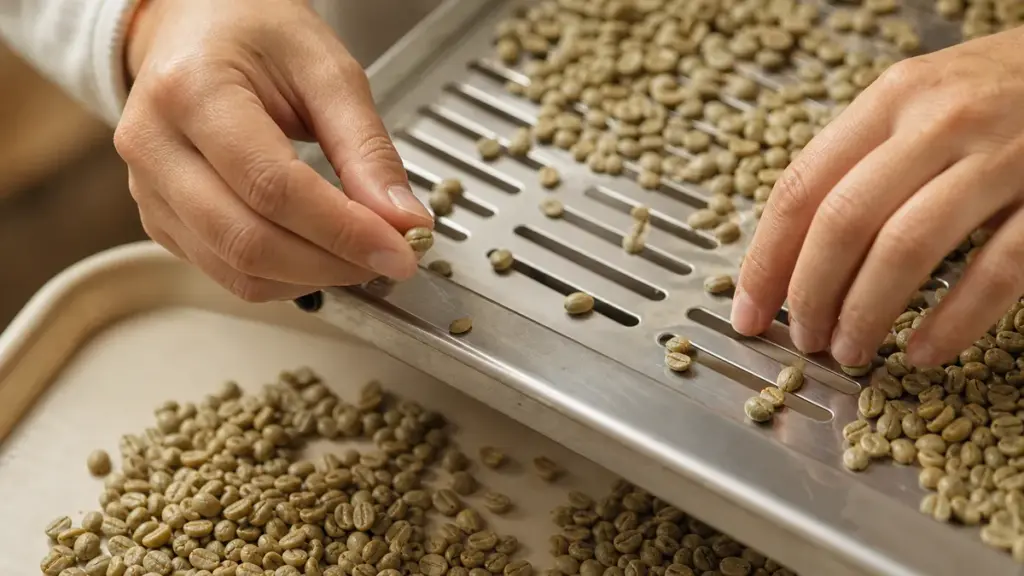
- Mills separate peaberries using grading equipment, including slotted screens.
- Shape can affect roasting behaviour, but there is no universal peaberry roasting formula.
- Tanzania and Kenya both sell PB grades. The letters identify a physical bean category, not a guaranteed tasting score.
What makes a coffee bean a peaberry?
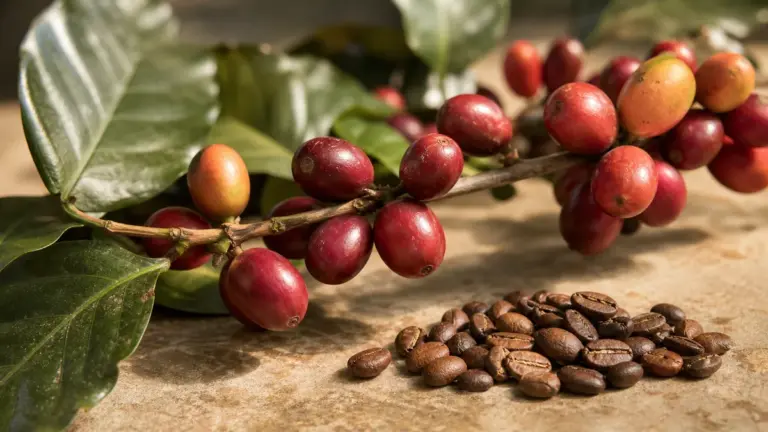
The familiar coffee bean is a seed. A coffee fruit, usually called a cherry, normally contains two seeds growing face to face. Each develops a rounded back and a flatter inner surface.
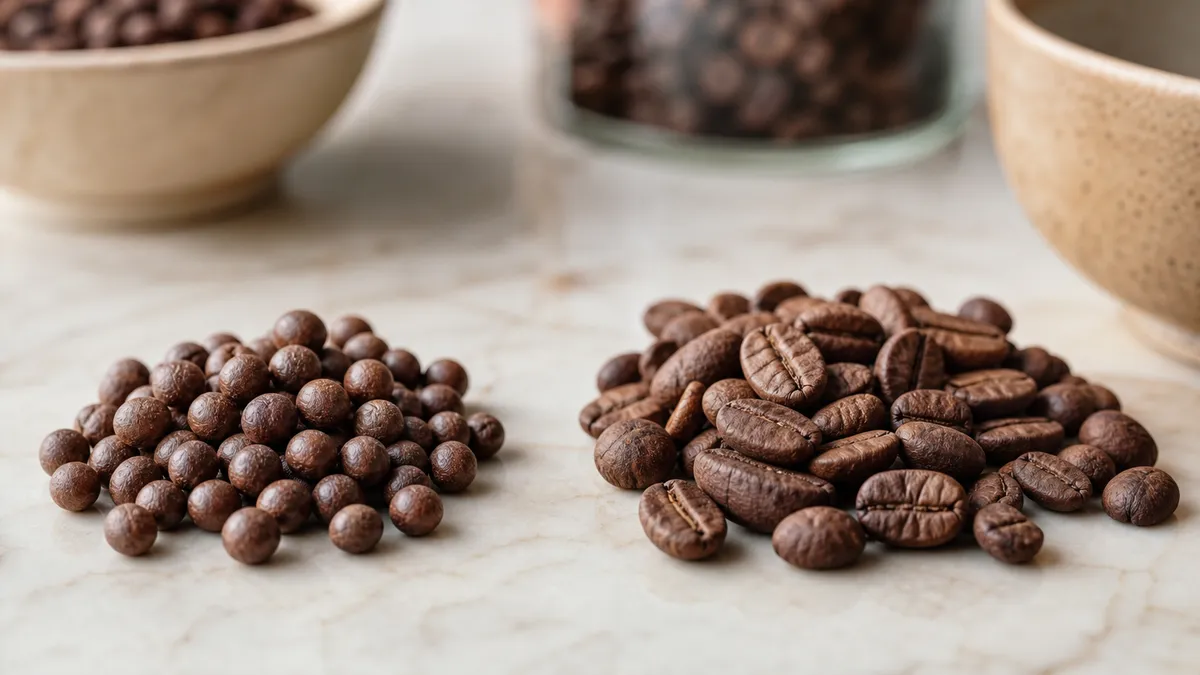
A peaberry develops alone. With no neighbouring seed occupying the other side of the fruit, it takes on a rounded or egg-like shape rather than the usual flat-sided form. Think of an oval bead rather than half a peanut.
Peaberry belongs to a different category from a botanical variety. Both arabica and robusta can produce peaberries: the term describes how an individual seed developed, not which species or cultivated variety produced it. Our coffee varieties guide explains the wider naming system.
That distinction matters when reading a bag. “Tanzania peaberry” gives you a country and a bean category, but it does not, by itself, identify the farm, variety, processing method or roast.
How to recognise one
| Feature | Ordinary flat-sided bean | Peaberry |
|---|---|---|
| Development inside the cherry | Usually one of a pair | A single developed seed |
| Overall shape | Rounded back with a flatter face | Rounded or oval, without a broad flat face |
| Central groove | Usually visible along the flatter face | Can still be present |
| Meaning for flavour | Must be assessed by tasting | Must also be assessed by tasting |
The groove is worth noticing. Descriptions sometimes claim that peaberries have “no crease”, but research describes their longitudinal groove too. No flat face does not mean no groove.
How a peaberry forms
The coffee flower’s ovary normally contains two ovules, the structures that can develop into seeds after fertilisation. Peaberry formation occurs when only one develops successfully.
The underlying failure can involve fertilisation or the early abortion of an ovule. An Indian breeding study published in 1990 linked peaberry development to space becoming available after one ovule aborted before fertilisation. The remaining seed could then develop into that space.
This needs a little care in the telling. A fruit with one rounded seed is not necessarily the same developmental outcome as a fruit containing one normal flat seed and an empty seed chamber. The Indian study distinguished peaberry formation from empty chambers associated with abnormalities after fertilisation.
It is therefore too simple to describe every peaberry as a particular genetic mutation. The visible result is clear, but appearance alone does not establish what caused development to fail in that individual fruit.
For the drinker, the useful point is straightforward: the round shape develops on the tree. It is not created by polishing, processing or roasting an ordinary flat bean.
What percentage of a crop is peaberry?
About 5% to 10% of cherries is a useful, commonly cited range, rather than a prediction for an individual farm. A University of California, Davis thesis uses that range explicitly for cherries; Cenicafé’s research summary gives a narrower estimate of 5% to 7% of harvested coffee.
Those statements are not perfectly interchangeable. A percentage counted from cherries is different from a percentage calculated from green-bean numbers or mass, because a peaberry cherry supplies one seed rather than two.
Use the range to understand that peaberries are a minority of the harvest. Do not treat it as a measured global constant, or assume that exactly the same proportion will appear in every bag.
How mills sort peaberry coffee
Peaberries sold as a separate lot have been selected from the wider coffee crop. This generally happens during dry milling, when dried coffee is hulled and the green beans are prepared for sale.
Screen grading separates beans according to their physical dimensions. Ordinary size screens have round openings, while slotted screens help separate peaberries because their thickness and shape differ from flat beans. The International Trade Centre describes the use of oblong slots for this purpose.
Sorting by shape is not the whole quality-control process. Density separation can remove lighter material, and coffee still needs assessment for defects and cup quality. Kenya’s Coffee Directorate describes physical grading and sensory analysis as distinct parts of preparation.
This is why “sorted peaberry” should not be read as “every bean is exceptional”. It tells you about the selected bean category, not everything that happened before or after selection.
It is also a useful reminder that coffee names do different jobs. Our guide to origin and grade names helps distinguish geographical descriptions from commercial classifications.
Does peaberry coffee roast differently?
It can, but “round beans always roast better” goes beyond the evidence.
A roasting profile is the pattern of heat applied over time. The practical question is whether a particular peaberry lot needs different treatment from the flat-bean portion, not whether roundness guarantees a better result.
In a 2023 experimental study using the arabica variety Cenicafé 1, researchers compared peaberries with standard beans through drying, roasting, grinding and tasting. They reported more even roasting and avoidance of burnt spots in the peaberries under the conditions tested.
That is useful evidence of a shape effect. It is not proof that every peaberry will roast evenly in every machine.
An earlier Brazilian experiment, published in 2009, found that roasting-temperature behaviour depended more on how heat was applied than on bean shape. Its green peaberry and flat-bean samples also showed no significant difference in bulk density. Claims that peaberries are always denser therefore need qualification.
For a roaster, the sensible response is to evaluate the lot rather than copy a supposedly universal peaberry profile. Compare roast development and taste the results before making a production decision.
For someone buying roasted beans, this work should already have been done. Ask what the roaster likes about the actual coffee, rather than accepting an explanation based only on its shape.
Flavour claims versus the evidence
Peaberry coffee is often presented as sweeter or more concentrated because the cherry develops only one seed. The appealing story is that one bean receives resources that would otherwise have been divided between two.
But a developmental explanation is not a tasting result. It does not establish that the roasted bean contains twice the flavour, or that the drink will be sweeter.
What comparative studies found
The Cenicafé experiment reported that peaberries achieved the same high cup scores as standard beans. This supports their ability to produce good coffee, not an automatic advantage over flat beans.
A 2019 Mexican study produced a different result in some comparisons. Researchers separated three Catimor varieties by size and shape, then assessed their cup quality. In one small-bean category of the variety Colombia, flat beans scored almost seven points above peaberries.
Other results in that study favoured mixed-shape samples over flat beans alone. The effect depended on the variety and size category, rather than producing a simple hierarchy with peaberry at the top.
These studies used different coffees and experimental conditions. They do not establish that peaberries are generally inferior either. Together, they show why a universal superiority claim is not justified.
What would make a convincing comparison?
For a useful tasting, ask for peaberry and flat-bean separations from the same harvest and source, with comparable processing and roast development. Even then, the result describes those coffees, not all peaberries.
Variety remains a separate part of the description. Names discussed in Ruiru 11, Batian and F1 hybrids tell you about planting material; PB tells you about bean formation and grading.
The best buying question is not “Are peaberries better?” It is “What evidence makes this particular lot worth trying?”
Tanzania and Kenya peaberries
Tanzania: read beyond the country name
Tanzania’s published coffee grading schedules include PB alongside flat-bean grades such as AA, A and B. PB is therefore an established trade classification, not merely wording invented for a retail bag.
However, “Tanzania peaberry” need not mean a single estate or one narrowly defined growing area. For example, Sucafina describes a fully washed PB offering assembled from smallholders in Songwe and Ruvuma in southern Tanzania.
When choosing a bag, ask for its region, producer or producer group, processing method and roast description. If the supplier gives tasting notes, treat them as a description of that offering rather than the flavour of every Tanzanian peaberry.
Kenya: PB is not a variety or a cup score
Kenya also recognises PB as a separate grade. Its Coffee Directorate defines the formation directly: one ovule develops instead of the usual two.
AA and AB describe flat-bean categories, while PB identifies the peaberry category. Kenya’s system also assesses the roasted coffee and liquor, meaning the brewed sample, separately from the physical grade.
Do not assume PB outranks AA or AB in the cup. Ask which producer or processing station supplied the coffee, which varieties are recorded, and why the roaster selected that particular lot.
A simple way to judge peaberry coffee
You do not need a laboratory to make a more useful buying decision.
- Check the description. Look for origin, producer information, processing and roast details, not just the word “peaberry”.
- Ask about the comparison. If the seller claims superior sweetness, ask whether that came from tasting matched lots or is a general description.
- Keep your first brew familiar. Use your established recipe and record the settings. Do not change everything because the beans look different.
- Compare without seeing the names. Have someone serve the coffees anonymously, then write down aroma, sweetness, acidity, texture and finish before revealing them.
- Choose the cup you prefer. A clear preference is useful for your next purchase, even though it does not prove that bean shape caused the difference.
Peaberry coffee is an interesting separation to explore. Let the unusual bean start the conversation, not decide the verdict.
FAQ
Can I use peaberry coffee for espresso?
Yes, you can choose a peaberry coffee for espresso. Start with a roast the supplier recommends for that use and your normal espresso recipe, then adjust according to the result. Treat this as a practical starting point, not a promise that PB beans require a particular grind setting or dose.
Should I remove round beans from an ordinary bag?
There is no reason to remove a sound bean simply because it is round. Research shows that peaberries can achieve good cup quality, including when assessed against standard beans. If you notice an unfamiliar flavour, investigate the coffee and preparation rather than assuming that the round beans caused it.
Does a PB label guarantee coffee from one farm?
No, PB does not guarantee a single farm. It identifies a bean category, and a peaberry offering can combine coffee from several producers, as the southern Tanzanian example above demonstrates. Look for a separate producer, estate, cooperative or lot description if traceability to a particular source matters to you.
Where to go next
Read Ethiopian Yirgacheffe and Colombian Supremo Explained to separate origin names from grading terms, then Ruiru 11, Batian and F1 Hybrids for the planting-material names you may encounter alongside Kenyan PB. Disease-Resistant and Climate-Resilient Varieties explains another distinction that peaberry coffee’s shape cannot tell you: what a variety was selected to withstand.
Sources
- Central Coffee Research Institute, Santa Ram, A., Sreenivasan, M. S. and Ramaiah, P. K. A Study of Peaberry Development: Its Implications in Coffee Breeding, Journal of Coffee Research, 20(1), 1990. Retrieved author-uploaded paper.
- Universidade Federal de Goiás, Silveira and colleagues. Population density of Arabica coffee cultivars for bean quality and yield, Pesquisa Agropecuária Tropical, 48(4), 2018. Retrieved paper.
- University of California, Davis, Rotta, N. Thesis on coffee postharvest processing and material flows, 2020, introductory coffee-cherry anatomy discussion, page 5. Retrieved thesis.
- Cenicafé, Duque-Dussán, E., Figueroa-Varela, P. A. and Sanz-Uribe, J. R. Peaberry shape and size influence on different coffee postharvest processes, Journal of Food Process Engineering, 46, e14461, 2023. Retrieved institute research summary.
- International Trade Centre. The Coffee Exporter’s Guide, third edition, 2011, chapter 11, size and density grading. Retrieved guide.
- Agriculture and Food Authority, Coffee Directorate, Kenya. Kenya Coffee Year Book 2022/23, published 2024, grading and quality-analysis sections. Retrieved yearbook.
- Pimenta, T. V. and colleagues. Roasting processing of dry coffee cherry: influence of grain shape and temperature on physical, chemical and sensorial grain properties, Boletim do CEPPA, 27(1), 2009. Retrieved paper.
- Colegio de Postgraduados, Luna González, A. and colleagues. Cup quality attributes of Catimors as affected by size and shape of coffee bean (Coffea arabica L.), International Journal of Food Properties, 22(1), 2019. Retrieved paper.
- Government of Tanzania. The Coffee Industry Regulations, Government Notice No. 385, 2013, mild coffee grading schedules. Used to document the published PB classification, not to advise on current regulatory compliance. Retrieved regulations.
- Sucafina. FAQ Peaberry FW, undated offering description, accessed November 2026. Used for the supplier’s stated southern Tanzanian provenance and processing, not as independent evidence of flavour superiority. Retrieved offering.
This article was researched using retrieved botanical and processing studies, official grading publications and a clearly identified supplier example; the tasting exercise is editorial guidance, not a report of first-hand testing.
Last checked: November 2026