Ethiopian Yirgacheffe names a coffee-growing place in Ethiopia, centred on Yirgacheffe in Gedeo zone; Colombian Supremo names a large-bean screen-size grade within Colombia’s Excelso export classifications. Neither is a coffee variety, and neither name alone guarantees how good the coffee will taste.
In short
- Yirgacheffe tells you about origin, not the genetic identity of the coffee plant.
- Supremo tells you about green-bean size, commonly described in trade as screen 17/18.
- The FNC definition specifies beans retained on screen 17, allowing up to 5% below that size, provided they are retained on screen 14.
- Excelso is also an umbrella export classification, not simply a smaller rival to Supremo.
- On a bag, look beyond the headline name for the producer or washing station, processing method, variety information, roast date and tasting description.
Ethiopian Yirgacheffe and Colombian Supremo describe different things
Coffee names become easier to read when you separate three questions: where was it grown, what plant produced it, and how was it classified? A single bag can answer all three, but the answers are not interchangeable.
A variety describes a cultivated type of coffee plant. An origin identifies a place. A physical grade describes characteristics of the harvested beans, such as their size or the permitted number of defects.
| Name or label | What it describes | What it does not establish |
|---|---|---|
| Ethiopian Yirgacheffe | A recognised Ethiopian coffee origin | One variety, one farm or one processing method |
| Colombian Supremo | Colombian origin plus a large-bean preparation | A particular variety or guaranteed tasting score |
| Castillo | A named coffee variety | A particular farm or screen-size grade |
| Washed | A processing method | An origin or plant variety |
These distinctions explain why a retailer’s list of “coffee varieties” can be misleading if it mixes Yirgacheffe, Supremo and actual variety names together. They are useful labels, but they belong in different categories.
Our coffee varieties guide provides the wider framework. Here, the useful task is learning exactly what these two familiar names reveal, and what still needs asking.
What Ethiopian Yirgacheffe means
A town, a district and a wider coffee origin
Yirgacheffe is a place in southern Ethiopia, including a town and district in Gedeo zone. On coffee bags, the name also identifies a recognised coffee origin that extends beyond the town itself.
That broader use matters. Coffee sold as Yirgacheffe may carry a more precise location such as Idido, Kochere or Gedeb. Those additional names help identify the source rather than contradicting the larger origin description.
For example, Ethiopian exporter CoffeeNet lists a washed Yirgacheffe coffee from Idido in Yirgacheffe district and a natural Yirgacheffe coffee from Lalesa in Gedeb district. Both sit within its Gedeo sourcing descriptions.
Read the name as a starting point for traceability, not as the address of one plantation. If you want to understand a particular bag, the cooperative, producer group or washing station is the useful next detail. A washing station is a facility where harvested coffee cherries are processed.
Not a single Ethiopian variety
A Yirgacheffe label does not identify one genetic type of coffee. Variety information belongs in a separate field, and the level of detail available varies between lots.
Some bags use broad wording such as “Ethiopian heirloom” or “local varieties”. These are not equivalent to naming one clearly identified cultivar. Others provide more specific information: CoffeeNet, for example, identifies Kurume in its descriptions of particular Yirgacheffe lots.
Avoid filling an information gap with an assumption. If the seller gives only “Yirgacheffe”, the variety has not thereby been established.
A flavour clue, not a flavour promise
Yirgacheffe has a strong association with fragrant, bright coffees. CoffeeNet describes its regional profile using floral, citrus, bergamot and tea-like characteristics, while the USAID-supported Ethiopian Coffee Buying Manual describes lemony acidity and sweetness in top washed examples.
Those are useful expectations, not a compulsory tasting checklist. The same manual recognises both washed and natural Yirgacheffe coffees, with berry characteristics occurring in some natural examples.
In washed processing, the fruit is removed before the coffee is dried in its parchment layer. In natural processing, the cherries dry whole before the dried fruit layers are removed. Check which process the bag names rather than assuming all Yirgacheffe is washed.
What Colombian Supremo means
A grade based on green-bean size
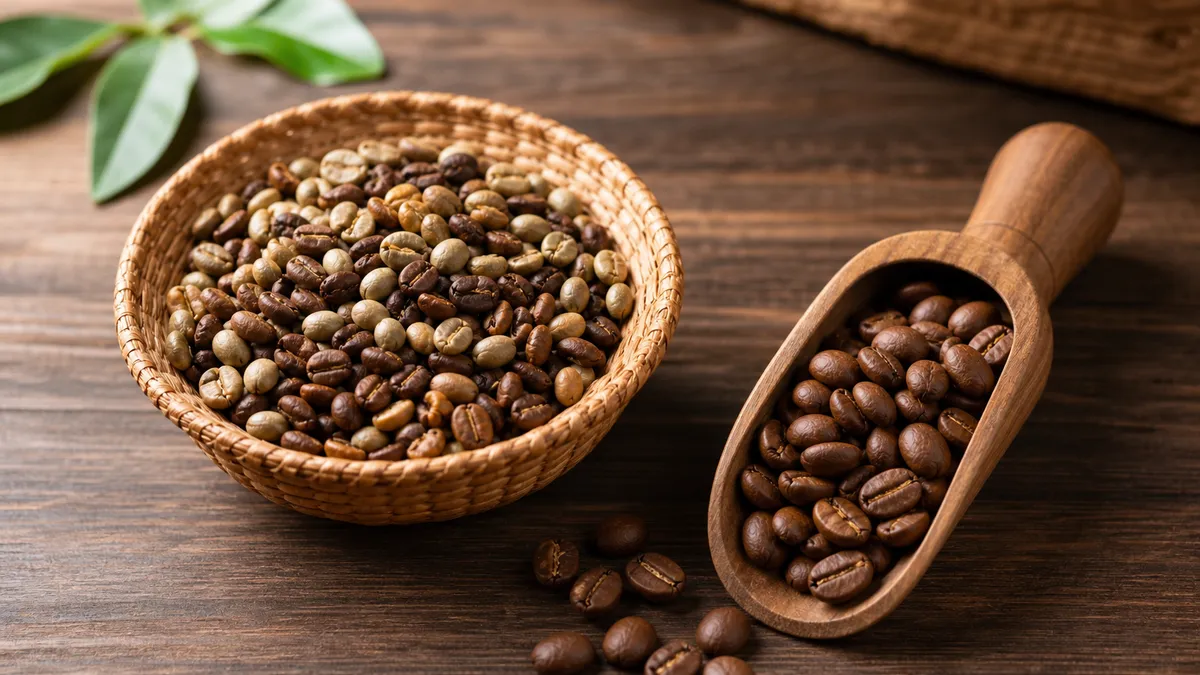
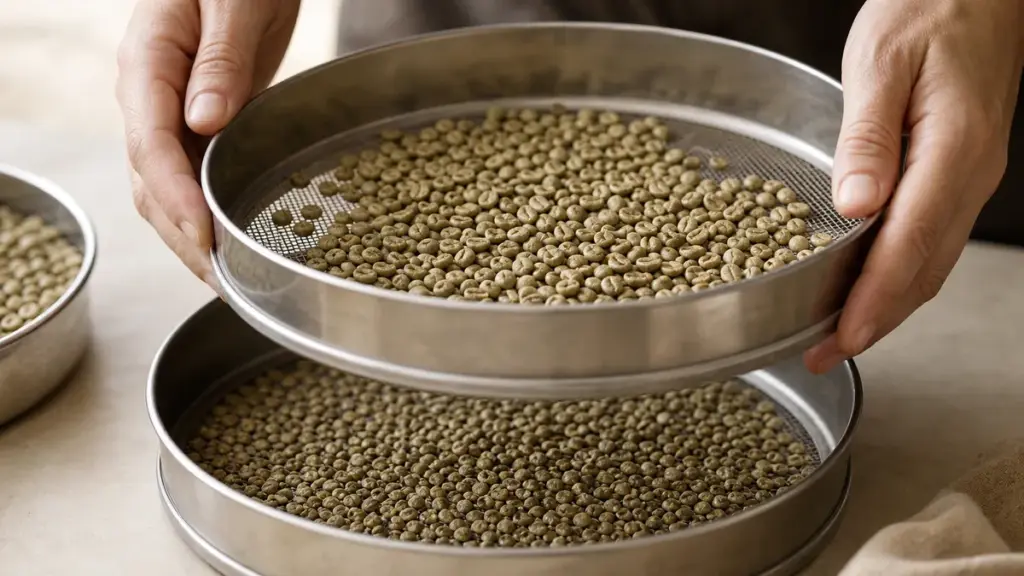
Supremo is a physical preparation associated with large Colombian green coffee beans. Screening happens before roasting: beans are separated using sieves with specified openings, with higher screen numbers indicating larger openings.
The Federación Nacional de Cafeteros de Colombia, usually shortened to FNC, defines Supremo as large, mainly flat, relatively even beans retained on screen 17. It permits up to 5% below that screen, but those smaller beans must still be retained on screen 14.
Consequently, “Supremo” does not mean that every bean is exactly the same size. It identifies a preparation with a stated tolerance.
You will commonly encounter the trade shorthand screen 17/18. However, the precise FNC definition is more useful than treating that shorthand as a promise that every bean falls into a tightly bounded pair of sizes.
Supremo sits within Excelso
The confusing part is that Excelso has both a broad classification role and a narrower everyday trade use.
FNC material lists Excelso Supremo alongside other Excelso preparations. Supremo is therefore not outside the Excelso family or a separate species of Colombian coffee.
In trade descriptions, “Excelso” is also commonly used for smaller-screen preparations, often described as screen 15/16. EP means European preparation, but the complete specification still matters.
The FNC’s published grading page identifies its Europa preparation with screen 15 and lists different permitted undersize tolerances. Therefore, “Excelso EP 15/16” is a useful commercial description, not a universal rule that every bean must be retained on screen 15 or 16 with no exceptions.
For green-coffee purchasing, ask for the actual screen specification and tolerance. For a roasted retail bag, remember the simpler distinction: Supremo indicates larger screened beans, not a higher guaranteed cupping score.
It does not name a variety
Colombian coffee can come from named varieties including Caturra, Typica and Castillo. Any variety claim needs its own evidence; “Supremo” cannot supply it.
This also separates Colombia, the country, from Colombia, a named coffee variety. A bag saying “Colombian Supremo” does not establish that the plants were the Colombia variety.
For the breeding background rather than the grading terminology, see Castillo and related varieties.
Why grading is not the same as cup quality
A physical grade answers a defined inspection question. A sensory assessment answers questions about aroma, flavour, texture and the evaluator’s impression of quality.
The Specialty Coffee Association’s Coffee Value Assessment keeps these dimensions separate. Its physical assessment considers attributes including size, moisture and defects; its descriptive assessment records sensory characteristics; its affective assessment captures perceived quality.
That separation is the right way to interpret Supremo. Large beans satisfy a size requirement, but size alone cannot establish sweetness, fragrance or a pleasant aftertaste. Equally, a smaller bean has not failed a flavour test merely by passing through a larger sieve.
Nor should “screen-size grade” be read as “nothing except size matters anywhere in the export system”. Colombian preparation descriptions also sit alongside selection and other quality requirements. The narrower point is that the Supremo name does not award a particular sensory result.
Yirgacheffe presents the opposite temptation: allowing a celebrated place name to stand in for evidence about the actual lot. Origin information is valuable, but ask what was produced there, by whom and how.
For a related distinction between bean appearance and plant identity, read peaberry coffee.
How to read the bag before choosing
Use this short sequence when comparing Ethiopian Yirgacheffe and Colombian Supremo. It is a label-reading method, not a ranking of the two coffees.
- Separate the information into categories. Identify origin, variety, processing method and grade. Do not let one impressive word answer all four questions.
- Look for a more precise source. For Yirgacheffe, seek a washing station, cooperative or producer. For Supremo, seek a Colombian region and producer information beyond the national name.
- Find the processing method. Look for a clear statement such as washed or natural. If it is absent, ask rather than infer it from the origin.
- Check the variety field. Accept “mixed” or “not specified” as information about the limits of traceability, not an invitation to invent a variety.
- Read the roaster’s description and intended use. Choose the stated flavour direction and brewing suitability you actually want, rather than assuming large beans or a famous origin must suit you.
- Check dates and lot identification. Ask for a roast date and, where available, crop or lot information so you can distinguish the coffee being offered from a general origin description.
A useful question for a roaster is: “What can you tell me about this lot beyond Yirgacheffe or Supremo?” A precise answer is more helpful than another adjective.
When choosing between them, start with your preference. If floral, citrus and tea-like descriptions appeal, investigate the particular Yirgacheffe offering. For Supremo, do not infer a flavour profile from the grade: let the lot description and tasting evidence guide you.
The best reading of Ethiopian Yirgacheffe and Colombian Supremo is therefore not “which name wins?” It is “what does each name tell me, and what information do I still need?”
FAQ
Can a coffee be both Supremo and Castillo?
Yes, a Colombian coffee can be described by both its Supremo preparation and its Castillo variety. The words answer different questions: Supremo concerns the screened green beans, while Castillo identifies the plant variety. However, a Supremo label alone is not evidence that the coffee is Castillo; the producer or seller must provide that information separately.
Is “single-origin Yirgacheffe” necessarily from one farm?
No, the wording does not by itself establish a single farm. Yirgacheffe is a recognised coffee origin, and a lot may have more detailed cooperative, village or processing-station traceability. If a single farm matters to you, look for an explicit producer and farm identification rather than treating the regional name as sufficient evidence.
Can I verify Supremo by looking at roasted beans?
Not reliably enough to confirm compliance with the green-coffee specification. Supremo is defined through screening green beans, so visual inspection of a roasted bag is not the specified test. For confirmation, ask the seller for the green lot’s preparation details, including its screen requirement and permitted undersize tolerance.
Where to go next
Read Coffee Varieties for the framework behind names on coffee bags, then Castillo, Catimor and Sarchimor for the breeding terminology that Supremo does not explain. Peaberry Coffee examines another frequently misunderstood bean classification and why appearance needs interpreting carefully.
Sources
-
Federación Nacional de Cafeteros de Colombia, “Colombian Coffee Grades”, undated Japanese-language grading page, retrieved November 2026. Screen definitions, Excelso preparations and tolerances.
URL: https://cafedecolombia.jp/colombia/specialty/grade/ -
Federación Nacional de Cafeteros de Colombia, Sostenibilidad en Acción 2013, published 2014, p. 105. Supremo definition and undersize allowance.
URL: https://federaciondecafeteros.org/static/files/FNC_informe_sostenibilidad_2013_V7.pdf -
Federación Nacional de Cafeteros de Colombia, Café de Colombia: Protected Geographical Indication Specification and Annexes, undated consolidated document hosted by GOV.UK, retrieved November 2026. Colombian varieties, preparation classifications and Supremo specification.
URL: https://assets.publishing.service.gov.uk/media/66584a667b792ffff71a8533/Cafe_de_Colombia.pdf -
Willem J. Boot, Fintrac for USAID, Ethiopian Coffee Buying Manual, March 2011. Yirgacheffe geography, processing, traditional variety diversity and sensory descriptions. Historical administrative descriptions were not treated as current boundaries.
URL: https://bootcoffee.com/wp-content/uploads/2013/01/Ethiopian_Coffee_Buying_Guide.pdf -
CoffeeNet Trading PLC, “Our Coffees”, undated exporter catalogue, retrieved November 2026. First-party descriptions of Gedeo sourcing, Yirgacheffe lots, Kurume and tasting characteristics. These are supplier descriptions, not independent tasting results.
URL: https://coffeenet.et/our-coffees -
World Coffee Research, “Coffee Varieties Catalog”, undated resource overview, retrieved November 2026. Variety terminology and the distinction between cultivated plant types.
URL: https://worldcoffeeresearch.org/resources/coffee-varieties-catalog -
Specialty Coffee Association, “Coffee Value Assessment”, undated framework overview, retrieved November 2026. Separation of physical, descriptive, affective and extrinsic assessment.
URL: https://sca.coffee/value-assessment
This article was researched using retrieved national coffee-body documents, a USAID-supported buying manual, World Coffee Research, SCA guidance and clearly attributed first-party exporter information; no first-hand testing is claimed.
Last checked: November 2026