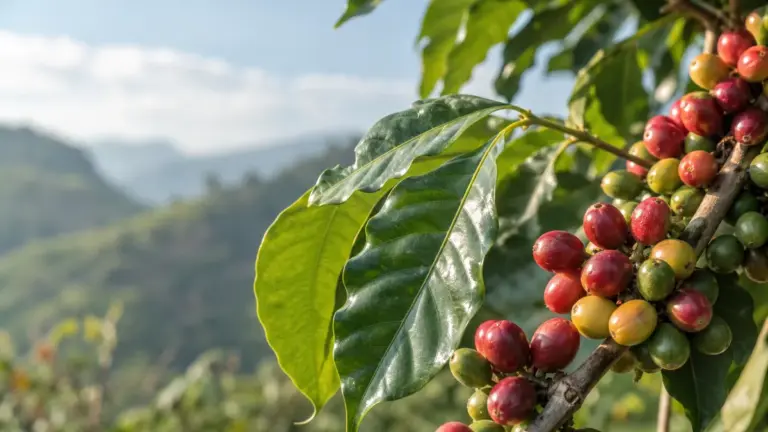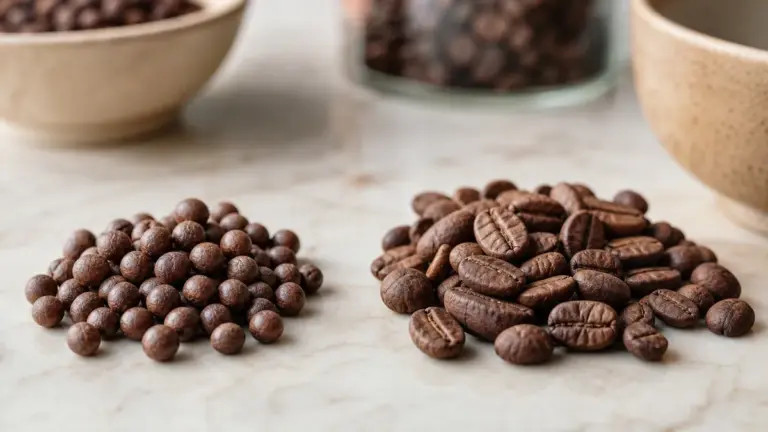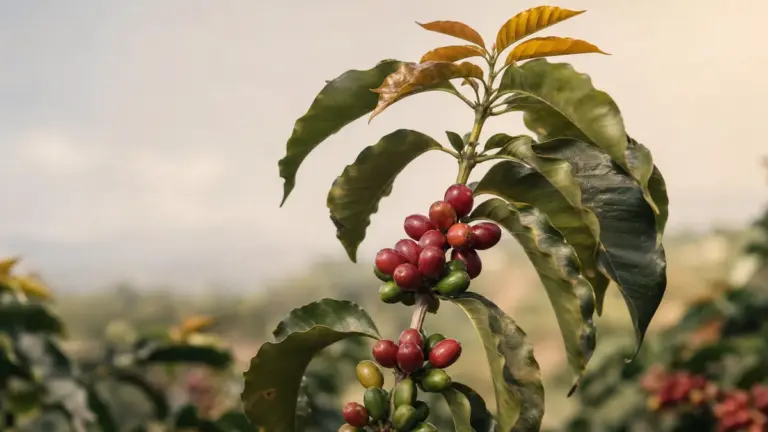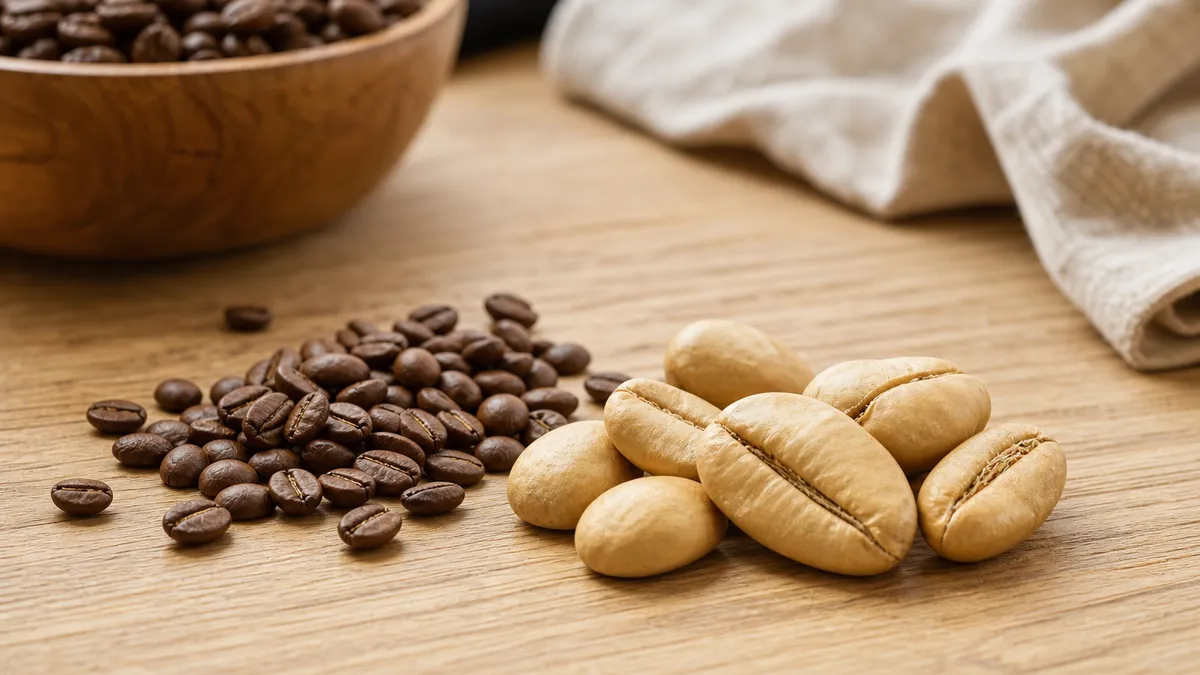
Maragogipe and Pacas are arabica coffee varieties distinguished by very different natural mutations: Maragogipe developed from Typica and produces exceptionally large beans, while Pacas developed from Bourbon and grows as a compact plant. They are also the parents of Pacamara, a deliberately bred variety that combines compact growth with very large beans.
In short
- Maragogipe’s mutation affects more than bean size: its leaves and the spaces between growth points are unusually large too.
- Pacas was discovered on a Pacas family farm in the Santa Ana region of El Salvador in 1949.
- Compact growth allows Pacas plants to be planted closer together, but does not give them resistance to coffee leaf rust.
- Pacamara is a cross, not another name for either parent, and its plants are not genetically uniform across generations.
- Neither bean size nor a variety name guarantees a particular flavour: growing conditions, processing, roasting and brewing also shape the cup.
Maragogipe and Pacas: the essential difference
The simplest distinction is large beans versus compact growth. Maragogipe’s most conspicuous feature is the size of its seeds, the part we roast as coffee beans. Pacas is chiefly distinguished by the smaller stature of the plant, rather than unusually small or large beans. World Coffee Research classifies Maragogipe’s bean size as very large and Pacas’s as average.
Both belong within Coffea arabica. Their names identify varieties, not countries, processing methods or roast styles. The wider coffee varieties guide provides the framework for reading these names on a coffee bag.
For buying purposes, treat the variety as one useful piece of information. Ask for the farm or producer, processing method and the roaster’s description of the actual batch before deciding which coffee sounds more appealing.
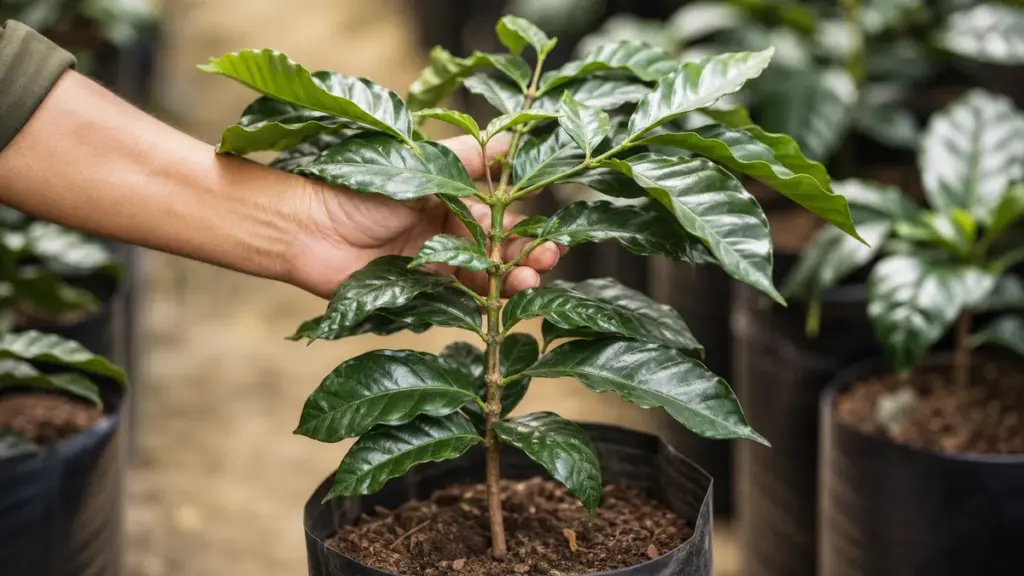
Maragogipe: the giant-bean Typica mutation
World Coffee Research records Maragogipe as a natural mutation of Typica, discovered near the Brazilian city of Maragogipe in 1870. It attributes the enlarged beans, leaves and internodes to a single dominant gene. An internode is the stretch of stem between successive nodes, the growth points where leaves or branches emerge.
That makes Maragogipe more than ordinary coffee sorted into a large size grade. Its distinctive proportions begin in the living plant.
What the plant is like
Guatemala’s national coffee association, Anacafé, describes Maragogipe as tall, with limited secondary branching and large, elongated red fruits. Its guide identifies low production and susceptibility to coffee leaf rust, while noting that its cup quality is valued in speciality markets.
The practical distinction is between bean size and crop yield. A plant can produce impressive individual beans without producing a large overall harvest. Maragogipe illustrates why those two characteristics should not be confused.
Anacafé gives an adaptation range of 1,300 to 1,800 metres above sea level in its Guatemalan guidance. This is a regional agronomic recommendation, not a worldwide boundary beyond which Maragogipe cannot grow.
What large beans do not tell you
A large Maragogipe bean is an identifying clue, not a tasting score. Before choosing it, look beyond photographs of the beans and ask what the roaster found in the cup.
Nor should an unusually large bean automatically be identified as Maragogipe. Pacamara also has very large beans, so appearance alone cannot reliably separate the parent from its offspring.
Pacas: the compact Bourbon mutation
Pacas is a natural mutation of Bourbon. According to World Coffee Research, it was discovered in 1949 on a farm belonging to the Pacas family in Santa Ana, El Salvador; the Salvadoran Institute for Coffee Research, ISIC, began a pedigree-selection programme in 1960. Pedigree selection means choosing individual plants and following their descendants through successive generations.
The distinction matters: discovering a naturally occurring plant and subsequently selecting its descendants is not the same as creating the original mutation through deliberate crossing.
Why compact growth matters
World Coffee Research describes Pacas’s smaller stature as the result of a single-gene mutation. The advantage is practical: plants can be positioned closer together, increasing the potential fruit production from a given area of land.
This is a different route to useful farm performance from producing oversized beans. Pacas changes the architecture of the planting, whereas Maragogipe is conspicuous for enlarged plant parts.
Compactness should not be mistaken for disease resistance. World Coffee Research describes Pacas as highly susceptible to coffee leaf rust. Its small stature is therefore an agronomic advantage with an important limitation, not an all-purpose improvement.
For a related comparison, other compact varieties and their relatives are a useful next step. Keep the questions separate as you read: how does the plant grow, how much can it produce, and what quality can its coffee achieve?
Origin and growing fact panel
These are varieties rather than geographical origins, so neither has one universal altitude range, processing method or harvest calendar. The panel separates regional guidance from named producer examples rather than presenting local information as a global rule.
| Fact | Maragogipe | Pacas |
|---|---|---|
| Main variety and lineage | Maragogipe, a natural Typica mutation | Pacas, a natural Bourbon mutation |
| Altitude context | Anacafé gives 1,300 to 1,800 metres for adaptation in Guatemala | El Salvador’s harvest manual describes cultivation at 800 to 1,500 metres |
| Processing context | Fully washed is documented for the Timbuyacu lot from Peru; this is not a variety requirement | Café Pacas reports washed, semi-washed, natural and honey processing across its coffees; confirm the method of the individual Pacas lot |
| Harvest months | March to September on Sucafina’s Timbuyacu listing, a named Peruvian example | October to March across Café Pacas’s Salvadoran farms, which include Pacas; not a variety-wide calendar |
| Cup-profile context | Good to very good quality potential in Central America according to World Coffee Research; the Timbuyacu listing describes berries and citrus | Salvadoran guidance describes cocoa, caramel and nut aromas, citrus acidity and a rounded, silky body |
Panel sources: World Coffee Research; Anacafé, Guía de variedades de café, third edition, 2020; Instituto Salvadoreño del Café, Manual de cosecha y poscosecha del café, 2024; Sucafina’s Timbuyacu listing; Café Pacas’s farm and processing pages. Producer and supplier descriptions are attributed examples, not independent testing.
What do Maragogipe and Pacas taste like?
The honest answer is that both have useful flavour descriptions, but neither has a fixed recipe of flavours.
For Maragogipe, the strongest general statement from World Coffee Research is good to very good cup quality in Central America. A more concrete example comes from Sucafina’s fully washed Timbuyacu coffee from Peru, described by the supplier as fruity and juicy, with berries and citrus. That describes one documented coffee, not every Maragogipe harvest.
For Pacas, El Salvador’s harvest and post-harvest manual offers a profile including cocoa, caramel, nuts and floral aromas, pleasant citrus acidity, and a rounded, silky body. These are useful expectations to explore, not a promise that every bag will taste of chocolate and almonds.
Separate flavour description from variety identification
World Coffee Research’s Sensory Lexicon provides a vocabulary for describing aromas, flavours and textures. It also explains that the sensory result reflects genetics, growing conditions and the coffee’s subsequent handling, including processing, storage, roasting and brewing. It is not a key that lets a taster identify a variety from one flavour note.
For a useful tasting comparison, choose coffees with clearly stated processing and broadly similar roast styles. Keep your preparation consistent and record aroma, acidity, sweetness, body and finish separately.
Treat this as an exploration rather than a controlled variety trial. If the coffees come from different farms or countries, write down those differences too. Avoid concluding that “Pacas tastes like this” after tasting one example.
The broader speciality varietals guide is useful for keeping quality potential separate from the performance of an individual batch.
How Maragogipe and Pacas became Pacamara
Pacamara brings the two family lines together:
Bourbon → Pacas
Typica → Maragogipe
Pacas × Maragogipe → Pacamara
World Coffee Research identifies ISIC as Pacamara’s breeder and records incomplete pedigree selection following the cross. Its catalogue describes a compact plant with very large beans and exceptional cup-quality potential at high altitude.
This makes Pacamara an instructive contrast with its parents. Maragogipe and Pacas began as natural mutations within existing varieties; Pacamara resulted from crossing those distinct parents.
Why the offspring is not completely predictable
World Coffee Research warns that Pacamara is not homogeneous and that plants are not stable from one generation to the next. In plain language, seed-grown descendants do not necessarily reproduce an entirely uniform set of characteristics.
That qualification belongs alongside the appealing description of compact plants and giant beans. Pacamara should not be presented as a perfectly consistent package containing only the most desirable features of both parents.
Disease susceptibility also remains relevant: World Coffee Research describes Pacamara as highly susceptible to coffee leaf rust. Exceptional cup potential is not the same thing as resilience in the field.
Choosing between them as a UK coffee buyer
My recommendation is to choose by the documented coffee first, variety second.
- Check identity. Look for an explicit variety declaration rather than relying on bean photographs.
- Check traceability. Prefer a named producer or clearly identified lot.
- Read the processing description. Do not assume the variety name tells you how the coffee was processed.
- Match the tasting notes to your preferences. Use the roaster’s batch-specific description rather than a generic variety profile.
- Keep a record. Note the origin, process, roast and your own impressions before comparing another example.
For curiosity about unusual bean morphology, Maragogipe is a particularly relevant choice. For understanding how compact growth can emerge within a familiar coffee family, Pacas is the more instructive case. Their shared offspring, Pacamara, then shows what deliberate crossing can add, and why inheritance still needs careful selection.
FAQ
Is Maragogype the same as Maragogipe?
Yes, Maragogype is an alternative spelling used in coffee commerce. World Coffee Research uses Maragogipe, while Sucafina uses Maragogype for its Timbuyacu listing and identifies the same Typica mutation. The spelling difference is not evidence of a separate variety, processing method or quality grade.
Does Pacas coffee have to come from El Salvador?
No. El Salvador is where Pacas was discovered, not the only country where it is grown. World Coffee Research also records cultivation in Honduras. When reading a bag, distinguish the variety’s historical origin from the country and farm that produced the coffee you are buying.
Can tasting notes prove that a coffee is Pacas or Maragogipe?
No, tasting notes alone cannot establish variety identity. Coffee flavour reflects genetics alongside growing conditions, processing, roasting and preparation. Treat flavour descriptions as guidance to the drinking experience, and ask the supplier for the coffee’s declared variety and traceability rather than inferring its identity from chocolate, citrus or floral notes.
Where to go next
Read Coffee Varieties to place Maragogipe and Pacas within the wider subject, then Specialty Coffee Varietals for guidance on interpreting variety-led descriptions. Caturra, Catuai and Mundo Novo provides a useful comparison with other important arabica varieties.
Sources
-
World Coffee Research. Arabica Coffee Varieties: Maragogipe. Live catalogue, publication year not stated.
https://varieties.worldcoffeeresearch.org/varieties/maragogipe -
World Coffee Research. Arabica Coffee Varieties: Pacas. Live catalogue, publication year not stated.
https://varieties.worldcoffeeresearch.org/varieties/pacas -
World Coffee Research. Arabica Coffee Varieties: Pacamara. Live catalogue, publication year not stated.
https://varieties.worldcoffeeresearch.org/varieties/PACAMARA -
World Coffee Research. Arabica Varieties, downloadable catalogue, retrieved version with file identifier dated December 2024. Used to cross-check plant stature, bean size and lineage.
https://cdn2.assets-servd.host/worldcoffee-research/production/pdf/catalogEnglish/Combined/arabica-1769602235.pdf?dm=1769602235 -
Asociación Nacional del Café, Anacafé. Guía de variedades de café. Third edition, 2020, Maragogipe section.
https://www.anacafe.org/uploads/file/8ee92f426ab648318001477e70d0bbe1/Gu%C3%ADa-de-variedades-Anacaf%C3%A9-2020.pdf -
Instituto Salvadoreño del Café, with support from the Italian Agency for Development Cooperation. Manual de cosecha y poscosecha del café. 2024, variety profiles.
-
Café Pacas. Fincas. Undated producer page, farm varieties and harvest calendar.
https://cafepacas.com/website/?page_id=8 -
Café Pacas. Beneficio. Undated producer page, processing methods.
https://cafepacas.com/website/?page_id=20 -
Sucafina. Timbuyacu Maragogype FW. Undated supplier lot page, processing, harvest months and attributed sensory description.
https://www.sucafina.com/emea/offerings/timbuyacu-maragogype-fw -
World Coffee Research. Sensory Lexicon: Unabridged. Version 2.0, 2017.
https://worldcoffeeresearch.org/download/bf904452-fc8c-488f-b591-c0b20d9bcab2
Research combined live checks of World Coffee Research’s variety records with national agronomic guidance and clearly attributed producer and supplier examples; no first-hand tasting or testing is claimed.
Last checked: November 2026