These Coffee FAQs give short answers to common questions about brewing, beans and caffeine. Use them for a quick explanation, then explore the site from the linked starting points when you want more detail.
Common Questions Answered
Where should I start if I am new to coffee?
Start with the drink you already enjoy, rather than trying to learn everything at once. Choose one brewing method, follow a repeatable recipe and change one thing at a time as you learn what you prefer. Our home page is the starting point for exploring the site.
Is espresso a special type of coffee bean?
No, espresso is a brewing method, not a species of bean or a particular roast level. It uses pressure to push hot water through finely ground coffee, producing a concentrated drink. Begin at the coffee guide home to explore coffee terminology and preparation.
FAQs About Brewing Methods
Are a cafetière and a French press the same thing?
Yes, cafetière and French press are names for the same brewing device. Ground coffee steeps in hot water, then a plunger with a mesh filter separates most of the grounds from the drink. Use the home page as your starting point for exploring brewing methods.
Can I use the same grind for every brewing method?
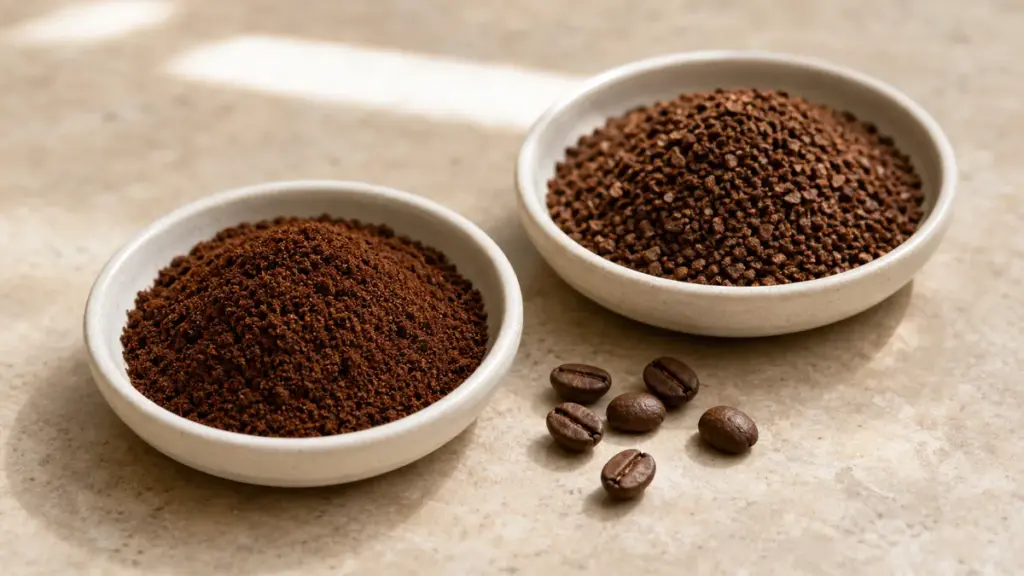
Usually not: espresso generally needs a fine grind, while a cafetière commonly starts with a coarser grind. The right setting depends on the brewer and recipe, so treat these as starting points rather than fixed rules. Explore further from the main coffee guide.
FAQs About Coffee Beans
What is the difference between arabica and robusta?
Arabica and robusta refer to different coffee species: Coffea arabica and Coffea canephora, respectively. They are not roast levels, and arabica itself contains many named varieties. For a route into the wider subject, start with the coffee guide home.
How should I store coffee beans?
Keep beans in an airtight, opaque container somewhere cool and dry, away from sunlight and heat. If you grind your own coffee, grind only what you need shortly before brewing. Continue exploring beans and preparation from the home page.
FAQs About Coffee Health
Health information, not personal medical advice: these answers describe population guidance, not an intake target or an assessment of your circumstances. Speak to a GP, pharmacist or midwife about caffeine if you have a medical condition, take medicines, are pregnant or have concerns about symptoms. Our editorial policy explains the standards behind the site’s information.
How much caffeine can a healthy adult have?
EFSA’s 2015 scientific risk assessment found that up to 400 mg a day, spread throughout the day, and single doses up to 200 mg raise no safety concerns for healthy, non-pregnant adults. These are not targets; individual sensitivity varies. See our editorial policy for how health evidence is handled.
Can I drink coffee during pregnancy?
The NHS advises no more than 200 mg of caffeine a day during pregnancy, counting all sources, not just coffee. Caffeine content varies between drinks, so a number of cups is not a reliable universal limit. Our editorial policy sets out the approach to sourcing health guidance.
Can coffee affect my sleep?
Yes, caffeine can affect sleep even below the general adult daily benchmark. EFSA’s assessment found that 100 mg close to bedtime may affect sleep duration and patterns in some adults. There is no single cut-off time that suits everyone. Read our editorial policy for the site’s evidence standards.
Does coffee count towards my fluid intake?
Yes, coffee counts towards daily fluid intake, according to NHS guidance. That does not mean caffeine is unlimited: the NHS also advises moderation and recognises that some people are more sensitive than others. Start at the home page to explore the wider coffee guide.
Where to go next
Visit Home to continue beyond these Coffee FAQs, or read About Us for the site’s purpose. Editorial Policy is the next stop for understanding how information should be researched, presented and maintained.
Sources
- National Coffee Association, Espresso, undated web guidance, accessed November 2026.
https://www.aboutcoffee.org/brewing/espresso/ - National Coffee Association, French press coffee, undated web guidance, accessed November 2026.
https://www.aboutcoffee.org/brewing/french-press-coffee/ - National Coffee Association, Storage and shelf life, undated web guidance, accessed November 2026.
https://www.aboutcoffee.org/beans/storage-and-shelf-life/ - World Coffee Research, Coffee varieties catalog: What’s included, undated online edition, accessed November 2026.
https://varieties.worldcoffeeresearch.org/about-the-catalog/whats-included - European Food Safety Authority, Caffeine, official summary of the 2015 Scientific Opinion, accessed November 2026.
https://www.efsa.europa.eu/en/topics/topic/caffeine - NHS, Foods to avoid in pregnancy, reviewed 15 June 2026.
https://www.nhs.uk/pregnancy/keeping-well/foods-to-avoid/ - NHS, Water, drinks and hydration, reviewed 17 May 2023.
https://www.nhs.uk/live-well/eat-well/food-guidelines-and-food-labels/water-drinks-nutrition/
This page was researched using retrieved coffee-industry guidance, World Coffee Research’s botanical reference and official NHS and EFSA health information, without first-hand equipment testing.
Last checked: November 2026