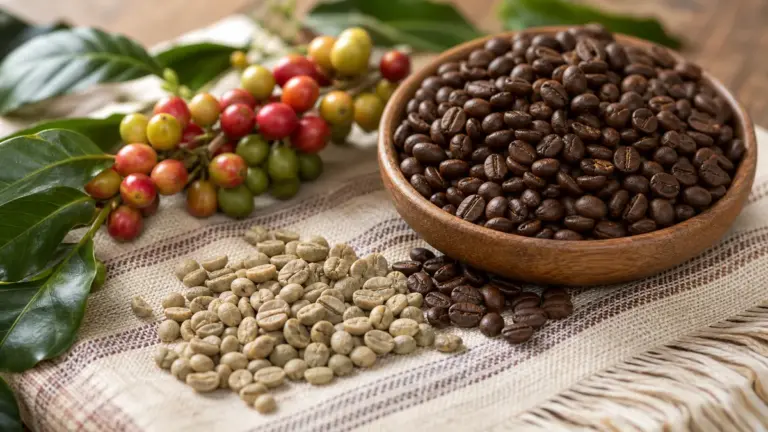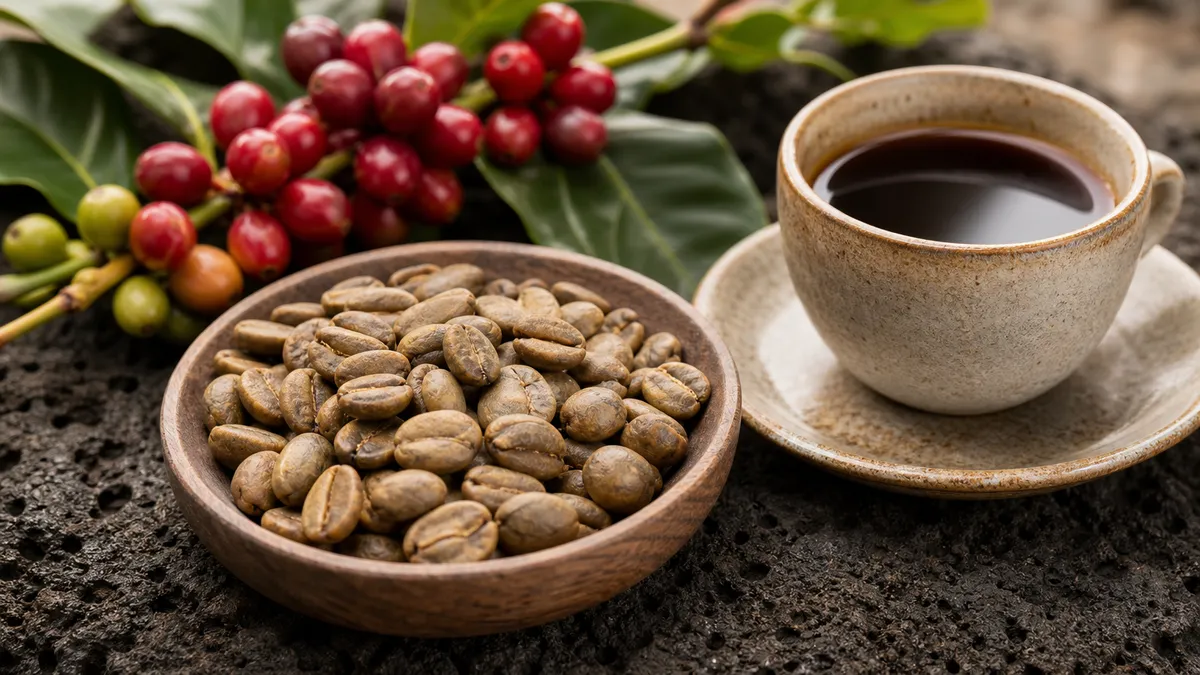
Hawaiian coffee is coffee grown in Hawaii, with Kona its best-known regional name, rather than a variety or roast style. Kona’s reputation rests on its distinctive growing conditions, established farming tradition and balanced, often citrus-and-nut-toned coffees, but buying well means distinguishing genuine regional coffee from a blend containing only a small proportion of it.
In short
- Kona is one growing region on Hawaii Island, not another name for all Hawaiian coffee.
- Commercial Hawaiian coffee is predominantly arabica, with Kona Typica particularly associated with Kona.
- In November 2026, applicable blends naming a Hawaiian origin must contain at least 10% coffee from that named origin by weight.
- From 1 July 2027, that minimum rises to 51% from the named origin, not simply 51% from anywhere in Hawaii.
- For an origin-focused purchase, look for an explicit regional percentage, producer information, processing method and roast date.
What makes Kona coffee distinctive?
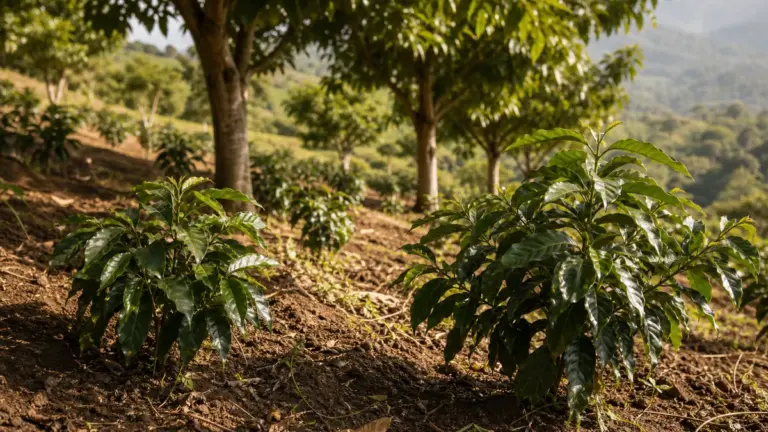
Kona coffee comes from the western slopes of Hualālai and Mauna Loa on Hawaii Island, often called the Big Island. Its growing conditions include shelter from the prevailing trade winds, afternoon cloud and rain, and volcanic ground that can be rocky rather than deep, uniform farmland.
The appeal is not simply “coffee grown on a volcano”. Kona combines a particular climate, farming tradition and planting material, especially the arabica variety commonly called Kona Typica. Its regional identity matters, but it does not make every farm, harvest or roast taste identical.
The Kona Coffee Farmers Association describes its traditional cup as balanced and smooth. Industry descriptions also include citrus, nuts, flowers and berries: useful expectations, not promises about every bag.
For the wider geographical context, start with North American coffee origins. Here, the useful distinction is between Hawaii as a US growing state, its individual islands and the smaller regions whose names appear on packets.
Hawaiian coffee fact panel
| Feature | What to know |
|---|---|
| Altitude | Kona’s published regional range is approximately 150 to 915 metres. This is a Kona reference, not a statewide altitude limit. |
| Main varieties | Kona Typica, Caturra and Catuai; other plantings include Bourbon, Mokka and SL28. |
| Processing | Washed processing is most common; honey, semi-washed and natural coffees are also produced. |
| Harvest months | Broadly August to March statewide, with variation between locations and seasons. |
| Typical cup profile | Kona often shows citrus, nutty, floral or berry notes with a smooth finish. Other Hawaiian coffees extend into chocolate, cherry and fuller-bodied profiles. |
The panel draws on the Hawaii Coffee Industry’s regional, varieties and cultivation references. Altitude has been rounded into metric units from its published Kona range.
Growing conditions: why modest altitude can work
Altitude is useful information, but it is not a universal quality score. Hawaii’s position farther from the equator means that suitable coffee-growing temperatures occur at lower elevations than in many equatorial origins.
The University of Hawaii’s cultivation manual explains that latitude and elevation both influence temperature. Comparing a Hawaiian farm with an equatorial mountain farm solely by metres above sea level therefore misses an important part of the growing environment.
Conditions also differ within the islands. Windward sites can have abundant rainfall and less predictable flowering and harvesting seasons, while drier locations may need irrigation. Waialua Estate on Oahu, for example, reports supplementing rainfall with drip irrigation.
Volcanic soil is not a guarantee of quality either. Drainage, rooting conditions and crop management still matter. The practical buying lesson is to favour a traceable farm and lot over an attractive description of the ground beneath it.
Beyond Kona: other Hawaiian regions and islands
Kona deserves attention, but it should not stand in for the entire state.
On Hawaii Island, other producing areas include Ka‘ū, Puna and Hāmākua. Industry descriptions associate Ka‘ū with chocolate, cherry, floral and citrus notes; Puna with fuller-bodied, sometimes wine-like or stone-fruit profiles; and Hāmākua with citrus, cocoa and nuts.
Maui includes both larger-scale production and smaller upcountry farms. Kauai has substantial commercial production, while Molokai also has an established coffee-growing industry. These islands broaden the picture beyond Kona’s small-farm identity.
On Oahu, Waialua is a useful name to recognise. Waialua Estate identifies its North Shore crop as arabica Typica and describes hedgerow planting designed for mechanical harvesting.
Treat regional flavour descriptions as starting points for choosing a sample, not rigid island-wide signatures. Ask what is distinctive about the particular lot being offered.
Varieties and processing: read beyond the origin name
Arabica, or Coffea arabica, is the species. Typica, Caturra and Catuai are varieties within it. Kona identifies a growing origin, while washed describes processing after harvest.
That distinction helps make sense of a detailed label: “Kona, Typica, washed” gives three different kinds of information.
The Hawaii Coffee Industry identifies Kona Typica as the variety most commonly associated with Kona. It also records Caturra in Ka‘ū, Puna, Hilo and Maui, and Catuai across several islands and Hawaii Island regions. Smaller plantings add further diversity.
World Coffee Research describes Typica as having very good quality potential but low yields and susceptibility to major diseases. Catuai is a compact variety bred from Mundo Novo and Caturra. These are agricultural characteristics, not guarantees of what a particular roasted coffee will taste like.
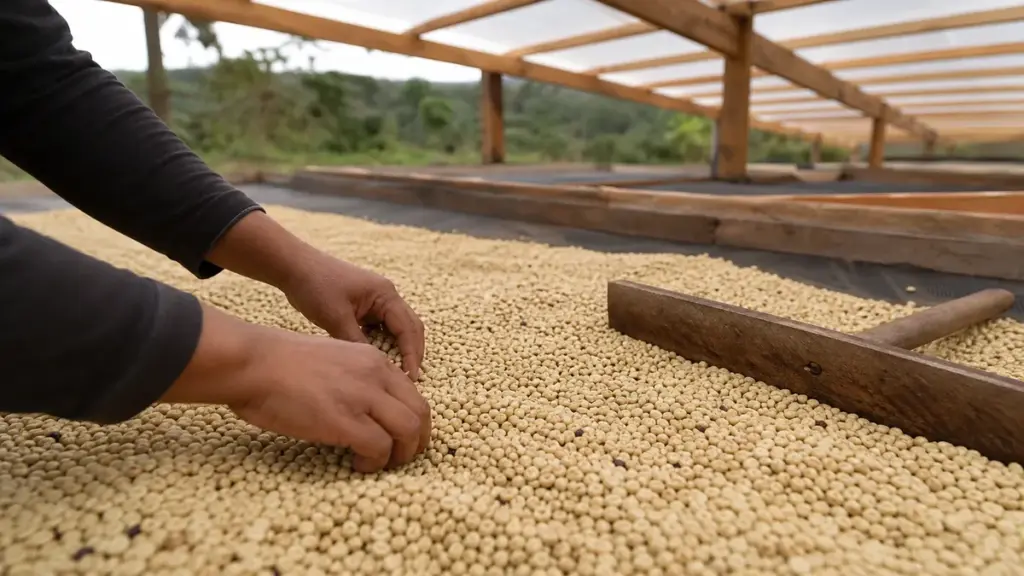
Washed processing, the most common Hawaiian method, removes the fruit and its sticky coating before the beans are dried. Honey processing retains some of that coating during drying; natural processing dries the coffee within the fruit.
For buying, request the actual method rather than assuming all Kona is prepared the same way. A regional name alone leaves much of the coffee’s production story untold.
Production costs: what the reputation does not explain
Hawaii’s production costs have practical causes, not just a famous name. Research identifies labour as a major production input, with hand harvesting particularly important on Hawaii Island’s rough terrain and closely planted farms.
Harvesting is only part of the work. Pruning, crop monitoring, pest management, processing and sorting all require labour and equipment. Mechanically harvested estates elsewhere in the state operate differently from small, hand-picked farms.
Pests add another layer. Coffee berry borer damages the crop and creates additional monitoring, sanitation and control work. A peer-reviewed economic assessment found that its arrival increased production and labour costs while reducing yield and quality. Research on commercial Hawaiian farms has also documented the management burden of coffee leaf rust.
None of this proves that a particular packet will be exceptional. Production difficulty explains some of the work behind a coffee; it does not replace evidence about its provenance, handling or flavour.
For a workplace purchase, request an itemised written quotation covering the coffee, pack size, delivery, supply continuity and any service commitments. Compare like-for-like regional percentages and specifications, rather than treating every product carrying “Kona” as equivalent.
Kona blends and Hawaiian labelling rules
The present rule and the scheduled change are different. The relevant provision is Hawaii Revised Statutes §486-120.6, as amended by Act 198 of 2024. The state’s February 2026 guidance confirms the transition below.
These are Hawaii state requirements. They should not be treated as an automatic guarantee about every packet offered by a UK seller.
The position in November 2026
Until 30 June 2027, covered products using a Hawaiian geographical origin in their labelling or advertising must contain at least 10% coffee by weight from that origin.
For a blend containing Hawaiian and non-Hawaiian coffee, the identity statement must specify the percentage, the named Hawaiian origin and “Coffee Blend”.
The front label must also carry a “Contains:” listing beneath the identity statement. It gives origins and their percentages in descending order. Non-Hawaiian origins may instead be consolidated into a percentage described as “Foreign-grown Coffee”.
The important point is that the minimum relates to the origin named. Coffee grown elsewhere in Hawaii does not become Kona merely by sharing the same state.
What changes on 1 July 2027?
From 1 July 2027, applicable blends using a Hawaiian geographical name must contain at least 51% coffee by weight from that named origin.
For a Kona-labelled blend, that means Kona coffee, not an interchangeable mixture of Hawaiian regions. The percentage refers to the coffee component, not the proportion of an entire ready-to-drink beverage.
Act 211 of 2023 introduced earlier labelling reforms; Act 198 of 2024 is the later amendment establishing this transition. Describing the 51% threshold as already operative in November 2026 would be wrong.
What about 100% Kona and “All Hawaiian”?
For coffee wholly from one Hawaiian geographical origin, the identity statement is the origin followed by “Coffee”. “100%” may precede it. The state’s guidance therefore gives both “Kona Coffee” and “100% Kona Coffee” as single-origin examples.
“All Hawaiian” has a separate meaning: the coffee must be entirely grown and processed in Hawaii. It is not a synonym for 100% Kona, because it can involve more than one Hawaiian growing region.
For UK readers, an explicit percentage is the clearest starting point. Ask the seller for the full label and provenance rather than interpreting a prominent island name or tropical design as proof.
Grades, flavour and buying advice
Hawaiian grading terms and regional percentages answer different questions. Extra Fancy is a green-coffee grade, not a variety, processing method or tasting score.
The state describes grading criteria including cleanliness, colour, roasting quality, defects, bean size and moisture. “Extra Fancy” therefore provides useful specification information, but it cannot tell you whether you will prefer that coffee’s flavour.
For a first Hawaiian purchase, use this checklist:
- Establish the origin percentage. If the aim is to taste Kona itself, choose an explicitly identified 100% Kona product.
- Request traceability. Ask for the farm, producer or regional lot information, not just the location of the roastery.
- Check the variety and processing. These help distinguish coffees carrying the same regional name.
- Ask for the roast date and intended brewing use. Make the purchase around how you actually prepare coffee.
- Read tasting notes as descriptions. Citrus, chocolate or cherry notes are not promises that every drinker will perceive the same thing.
- Look beyond Kona. Ka‘ū or another clearly identified Hawaiian origin may be a more interesting comparison than another indistinct blend.
An editorial recommendation: begin with one traceable regional coffee before comparing blends. That gives the geographical name something concrete to mean in your cup.
If you want a broader origin comparison afterwards, the separate Mexican coffee guide is the appropriate next step rather than assuming nearby origins are interchangeable.
FAQ
Is Kona coffee the same as Hawaiian coffee?
No. Kona is one growing region on the western slopes of Hualālai and Mauna Loa on Hawaii Island. Other Hawaiian coffees come from Ka‘ū, Puna and Hāmākua, and from Maui, Kauai, Molokai and Oahu.
How much Kona must a Kona blend contain?
Under Hawaii state rules, a blend naming a Hawaiian origin must contain at least 10% coffee by weight from that origin until 30 June 2027. From 1 July 2027 the minimum rises to 51% from the named origin.
What does Extra Fancy mean?
Extra Fancy is a green coffee grade based on criteria such as cleanliness, colour, roasting quality, defects, bean size and moisture. It is not a variety, a processing method or a tasting score.
What does Kona coffee taste like?
The Kona Coffee Farmers Association describes its traditional cup as balanced and smooth, often with citrus, nutty, floral or berry notes. These are useful expectations, not promises about every bag.
Why does Hawaiian coffee grow at lower altitudes?
Hawaii lies farther from the equator, so suitable growing temperatures occur at lower elevations than in many equatorial origins. Kona’s published range is roughly 150 to 915 metres.
Where to go next
Read North America for the regional overview and a wider context for Hawaiian coffee. Mexico provides the next country-level comparison once you have explored Hawaii beyond the Kona name.
Sources
-
Hawaii State Legislature, Hawaii Revised Statutes §486-120.6: Hawaii-grown and Hawaii-processed coffee; labeling or advertising requirements, current online text retrieved November 2026.
https://data.capitol.hawaii.gov/hrscurrent/Vol11_Ch0476-0490/HRS0486/HRS_0486-0120_0006.htm -
Hawaii State Legislature, Act 198, Session Laws of Hawaii 2024, 2024.
https://data.capitol.hawaii.gov/sessions/sessionlaws/Years/SLH2024/SLH2024_Act198.pdf -
Hawaii Department of Agriculture and Biosecurity, 2026 Update on State and Federal Coffee Labeling Laws, presentation by Leo Obaldo and Richard Cohen, 24 February 2026, hosted by the Kona Coffee Farmers Association.
https://konacoffeefarmers.org/wp-content/uploads/2026/02/State-Federal-Coffee-Labeling-Laws-by-Leo-Obaldo-Rick-Cohen.pdf -
Hawaii Department of Agriculture and Biosecurity, Labeling Law for Hawai‘i-Grown Roasted and Instant Coffee, guidance on the 2024 amendment, undated webpage.
https://dab.hawaii.gov/qad/commodities-branch/60-2/ -
University of Hawaii at Mānoa, CTAHR, H. C. Bittenbender and Virginia Easton Smith, Growing Coffee in Hawaii, revised edition, 2008.
https://www.ctahr.hawaii.edu/oc/freepubs/pdf/coffee08.pdf -
Synergistic Hawaii Agriculture Council, Hawaii Coffee Industry, Hawaii Coffee Growing Regions, Coffee Varieties and Cultivation, undated webpages.
https://hawaiigrown.coffee/hawaii-coffee/hawaii-coffee-growing-regions/
https://hawaiigrown.coffee/from-harvest-to-cup/coffee-varieties/
https://hawaiigrown.coffee/from-harvest-to-cup/cultivation/ -
Kona Coffee Farmers Association, Kona Coffee’s Unique Ecological & Agronomical Profile, 2010.
https://konacoffeefarmers.org/100-kona-coffee/kona-coffees-unique-ecological-agronomical-profile/ -
World Coffee Research, Arabica Coffee Varieties: Typica and Catuai, current online catalogue, undated entries.
https://varieties.worldcoffeeresearch.org/varieties/typica
https://varieties.worldcoffeeresearch.org/varieties/catuai -
Waialua Estate, Waialua Estate Single Origin Coffee, producer’s published cultivation information, undated webpage.
-
Lee and colleagues, University of Hawaii and USDA Agricultural Research Service, Economic Benefits from Managing Coffee Berry Borer (Hypothenemus hampei) in Hawaii, Insects, volume 14, article 350, 2023.
https://pmc.ncbi.nlm.nih.gov/articles/PMC10143774/ -
USDA APHIS, Field Release of Phymastichus coffea for Biological Control of Coffee Berry Borer in Hawaii: Environmental Assessment, 2023.
https://www.aphis.usda.gov/sites/default/files/coffeeberry-borer-ea-final.pdf -
Johnson and colleagues, Monitoring Coffee Leaf Rust (Hemileia vastatrix) on Commercial Coffee Farms in Hawaii: Early Insights from the First Year of Disease Incursion, Agronomy, volume 12, article 1134, 2022.
https://doi.org/10.3390/agronomy12051134 -
Hawaii Department of Agriculture and Biosecurity, Statistics on Hawai‘i Green Coffee Grading, 2023 to 2025, January 2026.
https://dab.hawaii.gov/add/files/2026/02/Grading-Standards-for-Hawaii-Green-Coffee-2023-2025_Jan.2026-final.pdf
This article was researched from Hawaii legislation and official guidance, university cultivation references, World Coffee Research, producer and industry documentation, and peer-reviewed agricultural research; no first-hand tasting or farm inspection is claimed.
Last checked: November 2026