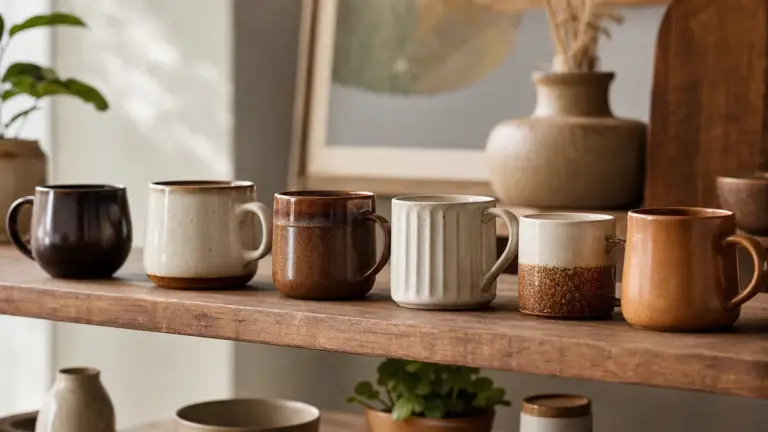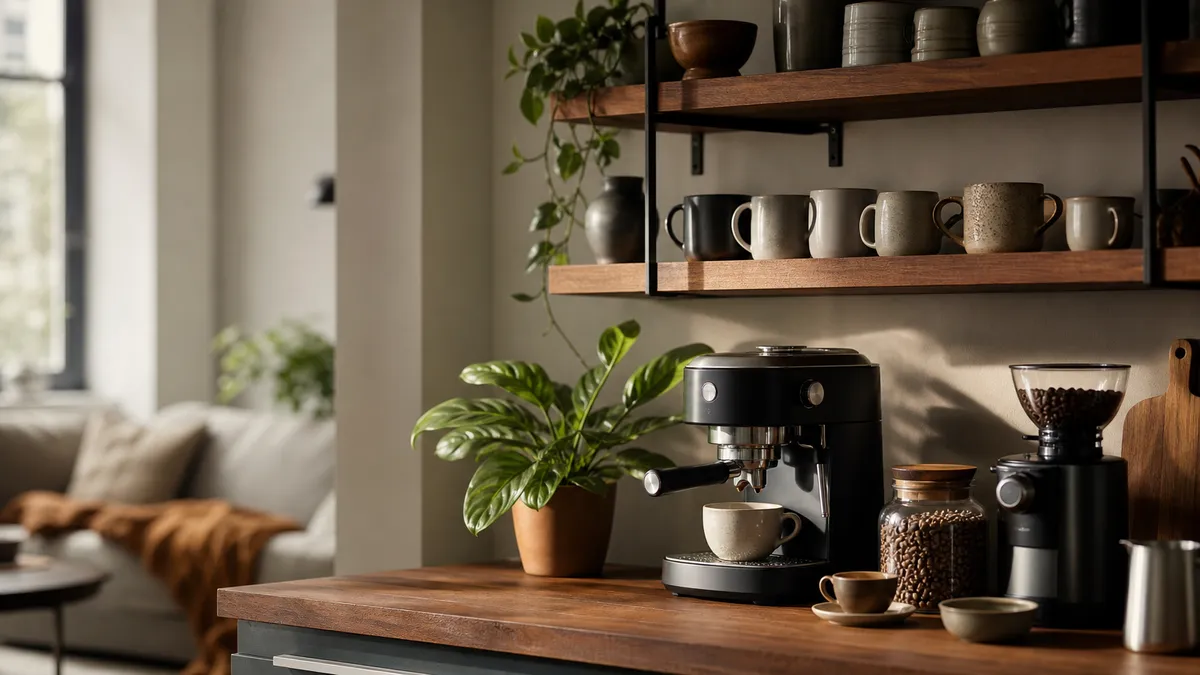
Coffee art and home décor work best when they make room for both brewing and personal taste: a useful coffee corner, equipment you enjoy looking at, and a small amount of well-chosen art. Start with the space your daily routine needs, then add materials, colours and objects that belong with the rest of your home.
In short
- Plan the working coffee corner before choosing shelves, pictures or ornaments.
- Use your favourite brewer or cups as the main display, rather than adding decoration to every surface.
- Check appliance access, socket positions and shelf installation instructions before committing to a layout.
- Choose worktop protection and cleaning methods for the specific material and finish.
- Keep valued paper artwork out of direct sunlight, and reserve a separate, dry place for it away from brewing.
Choose a direction for your coffee art and home décor
A coffee-inspired room does not need bean-patterned wallpaper or a collection of café signs. Our preference is to let useful objects carry most of the theme, with art providing a more personal reference.
Begin by looking at what is already in the room. Repeat a timber tone, a ceramic glaze or the colour of existing handles rather than introducing a completely separate miniature interior. A coffee corner should feel like part of your home, not an installation borrowed from somewhere else.
These are suggested combinations, not rules about which materials belong together:
| Direction | Suggested combination | Main decorative feature | Who it suits |
|---|---|---|---|
| Quiet and simple | Pale timber, cream ceramics, restrained metal details | One framed illustration | Someone who wants the coffee area to blend in |
| Workshop-inspired | Dark timber, stainless steel, plain storage | A neatly arranged brewer and grinder | Someone who enjoys equipment |
| Colour-led | Painted furniture, contrasting cups, a neutral worktop | A bold artwork or ceramic group | Someone comfortable with strong colour |
| Collected and personal | Existing furniture, varied pottery, a favourite coffee pot | Objects with a personal connection | Someone who dislikes matching sets |
Choose one direction as a starting point, then edit it to suit the room. For the wider selection of coffee-related objects, browse coffee merchandise and gifts.
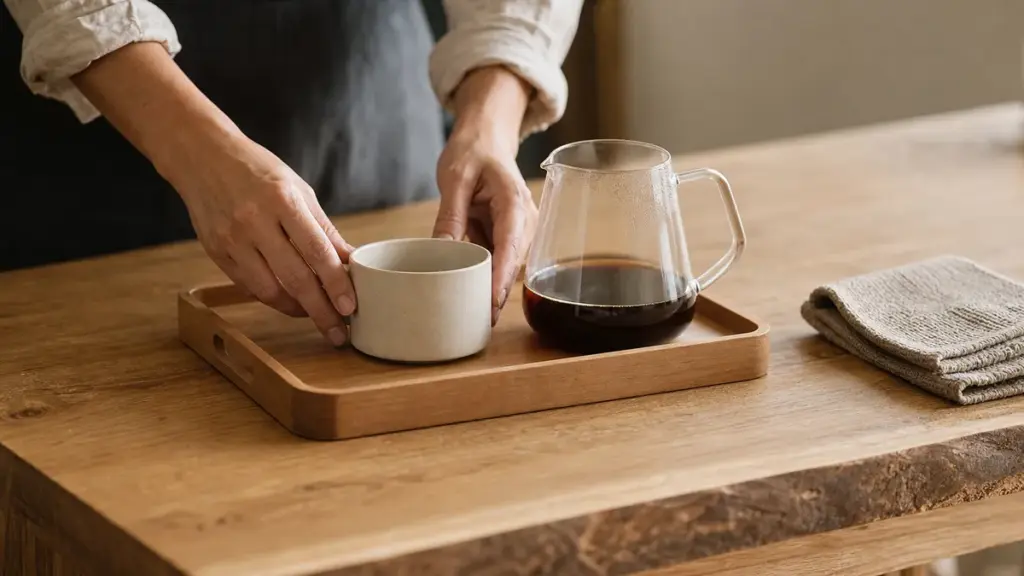
Plan a coffee corner around the way you brew
Start with a rehearsal, not a shopping list. Put your existing equipment in the proposed position and walk through making a drink, emptying it and cleaning up.
Give the working area priority
Measure the equipment’s footprint, then check how it opens. A machine may fit beneath a shelf while leaving no practical way to lift its water tank or fill its bean hopper. Record width, depth and height in millimetres, including the space needed for removable parts.
There is no useful universal clearance figure for every coffee machine. Follow the instructions for your particular appliance, including its positioning and ventilation requirements.
For a filter setup, rehearse the whole sequence with the kettle unplugged and empty. Where will you put the brewer after lifting it from the server? Where will the wet filter go? For an espresso setup, include space for preparing the coffee and dealing with the used grounds.
Keep the working route clear of decorative objects. You should not need to move a plant or picture every time you make coffee.
Check water, electricity and furniture
Choose furniture for the task before judging its appearance. Check the manufacturer’s stated load limits and installation requirements, including any required wall attachment.
Electrical Safety First advises keeping electrical equipment away from water, avoiding wet-handed operation and not overloading adaptors. If the preferred location needs additional sockets, ask a registered electrician rather than designing around a concealed cluster of adaptors.
Do not assume a decorative tray makes unsuitable furniture suitable for an appliance. Check both the appliance instructions and the care guidance for the surface underneath it.
Display equipment without making it awkward to use
A brewer can be the main visual feature. Give it enough surrounding space to be seen clearly, then keep the things used with it close at hand.
Try arranging the corner in functional groups:
- Brewing: the machine or manual brewer, grinder and everyday tools.
- Serving: frequently used cups, glasses and spoons.
- Storage: spare accessories and less-used pieces behind a door or in a drawer.
These groups need not become separate shelves. On a small worktop, simply deciding what stays visible and what goes away may be enough.
Keep working equipment on an appropriate, stable surface. Reserve display shelves for objects whose weight and placement suit the shelf’s instructions. IKEA’s shelf guidance illustrates why this matters: suitable fixings and permitted loads depend on the wall construction, not just the shelf itself.
For cups, choose an arrangement that lets you remove a favourite without dismantling a stack. A small, changing selection is our preferred approach: display what you are enjoying now and store the rest. For choosing the cups themselves, see coffee-designed mugs.
Older equipment can also be treated purely as a display object. If its condition or suitability for use is uncertain, keep decoration and brewing separate rather than assuming a handsome object is ready for service.
Choose art that has something to say
Coffee art can refer to the plant, the drink, the equipment or the social experience around it. Before choosing a picture, decide which of those interests you.
Possible subjects include a botanical illustration, a quiet photograph of a cup, an abstract painting using coffee-brown tones, or a drawing of a favourite brewing vessel. You do not have to choose literal coffee imagery: an artwork that shares the room’s colours may make a more satisfying companion.
Use a paper template to test the size and position before hanging. Look at it from the doorway and from where you normally sit, not only while standing directly in front of the coffee corner.
Keep valued paper artwork out of direct sunlight. The Canadian Conservation Institute explains that light damage depends on both intensity and exposure time, and that fading cannot truly be reversed. UV-filtering glazing is not a reason to leave a sensitive picture in strong daylight.
As a layout precaution, choose a separate, dry wall position away from the brewing action. Detailed choices about formats, framing and print subjects belong in coffee posters and prints.
Give cultural objects context
A coffee pot can be more interesting when you understand how it is used. UNESCO’s listing of Turkish coffee culture and tradition describes a practice rooted in preparation, conversation and hospitality, rather than simply a distinctive serving style.
If you display an object from a particular tradition, learn its correct name and purpose. Ask the maker or seller about its origin and whether it is intended for use or decoration. Avoid describing an object as “traditional” or “authentic” unless that description can be supported.
Choose materials by finish and care requirements
Colour and texture are only part of the decision. Before buying a shelf, tray or cabinet, ask what its surface tolerates and how it should be cleaned.
Timber: check the protective finish
Timber is our suggestion for introducing a warmer visual contrast beside metal or glass. However, the finish matters as much as the timber underneath.
Norfolk Oak describes its oiled worktops as water-resistant, not waterproof, and advises wiping up spills promptly rather than leaving liquid standing. That guidance applies to its oiled worktops; do not assume a painted cabinet, veneered shelf or unfinished board has the same care requirements.
Ask for written care instructions, especially when repurposing furniture not originally intended for kitchen use. Choose a removable tray only if its underside and use are compatible with the furniture.
Stone and engineered surfaces: do not assume immunity to heat
“Stone” is not a complete care specification. Identify the actual product and follow its supplier’s guidance.
For example, Caesarstone advises protecting its quartz surfaces from hot cookware and sudden extreme temperature changes. A surface described as durable still needs appropriate treatment. When setting down a hot brewing vessel, use protection suitable for both the vessel and the worktop.
Ceramics, glass, metal and textiles
For a restrained arrangement, try repeating one ceramic glaze or using plain glass beside a more detailed coffee pot. Alternatively, let a single metal object provide the contrast against painted furniture.
Check care instructions for each item rather than treating a whole material category alike. A decorative ceramic container is not automatically suitable for storing food, and appearance alone does not establish dishwasher suitability.
Use textiles sparingly in the working area. Our preference is to put pattern into a nearby cushion, chair or wall hanging, leaving the brewing surface straightforward to wipe and inspect. Keep fabrics clear of hot equipment and follow the appliance’s safety instructions.
Put the arrangement together in a practical order
Use this sequence to turn ideas into a coffee corner without buying everything at once.
- Audit what you own. Select the brewer, cups and objects you genuinely want to use or display.
- Measure the proposed space. Include appliance opening movements, removable parts and access to cleaning areas.
- Check instructions. Confirm furniture suitability, appliance positioning, shelf fixings and surface care.
- Rehearse the routine. Make a drink in the proposed arrangement before installing permanent decoration.
- Choose the focal point. Let either the equipment, artwork or ceramics lead, rather than making each compete.
- Add storage and decoration. Keep daily tools accessible and give less-used objects a deliberate home.
- Review after living with it. Remove anything repeatedly moved aside, splashed or left in the way.
For a small home, stop when the arrangement works. A tray of everyday equipment and one well-positioned picture can be a complete scheme.
For a larger room, resist filling every available shelf immediately. Leave space for the collection to develop through objects you actually enjoy using, rather than buying a finished coffee theme in one go.
FAQ
Can I create a coffee corner in a rented home?
Yes, you can plan one around existing, suitable furniture without making permanent alterations. Start with a freestanding arrangement and check your tenancy terms before drilling or attaching fixtures. Do not substitute adhesive fittings where a shelf or furniture manufacturer requires mechanical fixings. If the layout needs electrical changes, discuss them with the landlord and a registered electrician.
Does all the coffee equipment need to match?
No, matching is an aesthetic choice rather than a requirement. Our suggestion is to repeat one visible detail, such as a cup colour, timber tone or metal finish, while letting the equipment remain different. Try the arrangement with what you already own before replacing anything solely to create a coordinated appearance.
How can I give a coffee décor item without choosing the wrong style?
Choose something that reflects the recipient’s existing home rather than your ideal coffee corner. Ask about available space, preferred colours and whether they want a useful object or a decorative one. For artwork, check the subject and intended position together if possible. Avoid assuming that an enthusiastic coffee drinker also wants coffee slogans on display.
Where to go next
Read Coffee Posters and Prints to develop the artwork side of your coffee art and home décor, or Coffee-Themed Gifts when choosing an object for someone else’s home. Coffee T-Shirts and Hoodies takes the same interest into clothing rather than interiors.
Sources
-
Electrical Safety First, How Safe Is Your Home?, 2025 edition. Kitchen safety, adaptors and additional sockets.
https://www.electricalsafetyfirst.org.uk/media/0dupqu3p/how-safe-is-your-home-2025-edition.pdf -
Nespresso, Expert & Milk: User Manual, 2017. Appliance-specific examples of positioning, accessible electrical connections, hot surfaces and cleaning precautions. This does not replace the reader’s own appliance instructions.
https://www.nespresso.com/shared_res/manuals/expert/2016/UM_EXPERTandMILK_RC_KRUPS_PROD_2017_06_27.pdf -
IKEA, LACK: Advice and Instructions, document AA-2167989-6, undated. Wall materials, appropriate fixings and installation-dependent shelf loads.
https://www.ikea.com/us/en/manuals/lack-wall-shelf-white__AA-2167989-6-100.pdf -
Canadian Conservation Institute, Stefan Michalski, Agent of Deterioration: Light, Ultraviolet and Infrared, online edition, undated. Light exposure, fading and display precautions.
https://www.canada.ca/en/conservation-institute/services/agents-deterioration/light.html -
UNESCO, Turkish Coffee Culture and Tradition, 2013 inscription. Cultural context for preparation, serving and hospitality.
https://ich.unesco.org/en/RL/-00645 -
Norfolk Oak, Worktop Aftercare, undated. Manufacturer guidance for its oiled wooden worktops.
https://www.norfolkoak.com/worktops/worktop-information/aftercare/ -
Caesarstone UK, How to Clean & Maintain Caesarstone Quartz, undated. Manufacturer guidance on heat protection and cleaning.
https://www.caesarstone.co.uk/care-and-maintenance/quartz-surfaces/
This article was researched using retrieved cultural, conservation, electrical-safety and manufacturer guidance; aesthetic combinations and layout suggestions are editorial recommendations, not first-hand product testing.
Last checked: November 2026