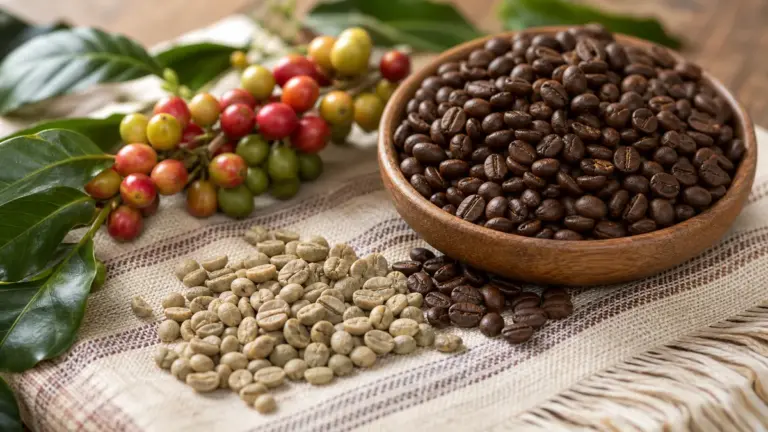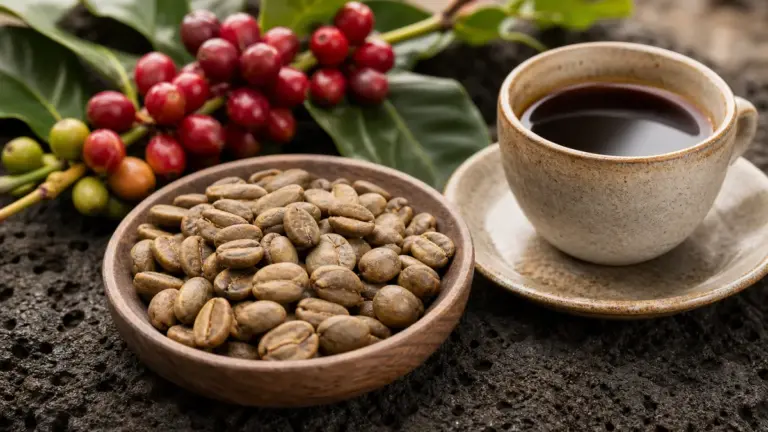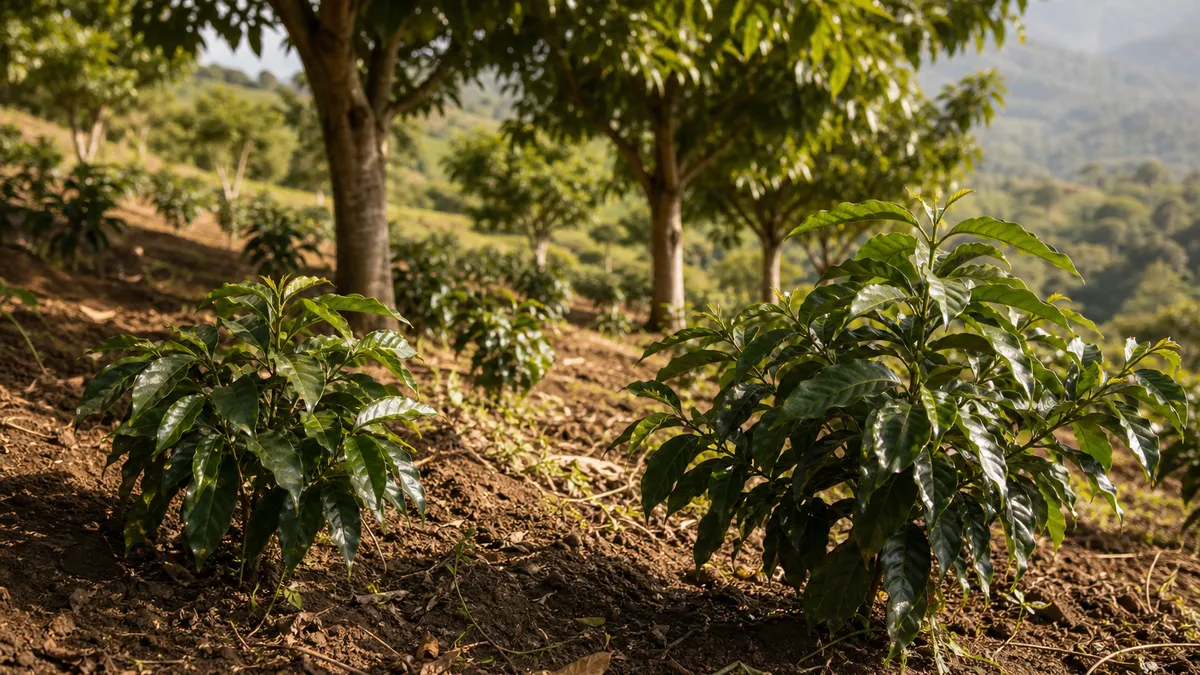
Yes, coffee really is grown in California, particularly in sheltered coastal areas where mild temperatures allow arabica plants to produce a commercial crop. It remains a small, experimental origin, built around individual farms, carefully processed lots and a growing understanding of what coffee needs outside the tropics.
In short
- Look for California-grown, not simply California-roasted: the latter does not identify where the beans were farmed.
- The modern commercial story centres on Jay Ruskey, Good Land Organics and coffee plants supplied by University of California farm adviser Dr Mark Gaskell in 2002.
- Growing areas include Santa Barbara, Ventura and San Diego counties, with the wider farm network extending into San Luis Obispo County.
- FRINJ gives its usual harvest window as May to late October, moving from southern farms towards Santa Barbara.
- Buy by named farm, variety and processing method. Published tasting notes describe particular lots, not a settled California-wide flavour.
California coffee at a glance
California is best understood as an emerging collection of farm-level origins rather than a large, uniform producing region. Even its basic reference figures need qualification: a company’s grower network is not a census of every coffee planting in the state.
| Feature | Documented position | Source basis |
|---|---|---|
| Altitude | Roughly 180 to 220 m in two documented farm examples: Good Land Organics and Knopf Knoll Ranch. This is an illustrative range, not statewide minimum and maximum elevations. | Ruskey’s 2011 grower interview; FRINJ’s Knopf Knoll lot description |
| Species and varieties | Arabica, Coffea arabica. Documented plantings or releases include Typica, Caturra, Catuaí, Geisha and Laurina; no verified statewide ranking by planted area was established. | Grower interview; FRINJ farm and product descriptions |
| Processing | Washed coffees, including yeast-inoculated and enzyme-assisted washed lots, are documented in current releases. | FRINJ product descriptions |
| Harvest | May to late October, according to FRINJ’s general harvest guidance; individual farms and seasons can differ. | FRINJ FAQ |
| Reported cup profile | Lot descriptions include apple, honey and flowers; pear, nougat and malted chocolate; or lime, jasmine and brown sugar. These are producer reports, not our tasting results. | FRINJ’s named-lot descriptions |
For the wider geographical context, start with North American coffee origins. California’s significance lies less in volume than in demonstrating that a carefully chosen coastal site can support a crop usually associated with tropical countries.
How California coffee farming developed
The modern story is a collaboration between a grower willing to experiment and an agricultural adviser familiar with coffee-producing countries. At Good Land Organics in Goleta, Santa Barbara County, Jay Ruskey was already exploring unusual fruit crops when Mark Gaskell introduced coffee plants.
There is a small but useful distinction in the historical record. A University of California report dates their wider coffee collaboration to 2001, while Ruskey’s account, published by the university, says Gaskell brought him his first coffee plants in 2002. These dates need not conflict: the beginning of a research collaboration and a particular planting are different milestones.
The aim was not merely to keep a tropical shrub alive. It was to establish whether coffee could bear useful crops, be processed successfully and produce beans that people wanted to drink.
A short timeline
- 2001: University of California reporting dates the Gaskell and Ruskey coffee collaboration to this year.
- 2002: Gaskell supplied Ruskey with the first coffee plants described in Ruskey’s later university-published account.
- 2014: Good Land Organics’ Caturra appeared in Coffee Review’s annual Top 30, as subsequently documented by the university.
- 2017: FRINJ Coffee was founded to help develop California coffee production, supplying expertise and connecting farming with processing and sales.
- 16 January 2024: FRINJ filed for Chapter 11 bankruptcy protection.
- 31 January 2025: Its legal representatives report confirmation of a reorganisation plan.
- 2026: Company statements and current lot descriptions document continuing operations and a post-harvest facility in Ventura County.
The history also requires a sad update. Jay and Kristen Ruskey died on 8 February 2026, according to FRINJ’s announcement. Their contribution remains central to the origin’s development, but descriptions presenting Jay as its current chief executive are now outdated.
Where coffee grows, and why the coast matters
The documented growing corridor runs through coastal and near-coastal parts of Southern and Central California. Goleta and Carpinteria are established Santa Barbara County examples; Ventura County includes Moorpark plantings, while Oceanside provides a documented San Diego County example. FRINJ describes its wider network as stretching from San Luis Obispo to San Diego.
This does not mean that coffee suits California generally. Site selection is the essential qualification.
University of California guidance identifies coastal conditions around 34° north in Santa Barbara and Ventura counties as broadly comparable with conditions found at higher elevations in tropical coffee regions. The relevant advantage is temperature moderation, not latitude as a magic ingredient.
Higher elevation commonly provides cooler conditions in the tropics. On the California coast, marine influence can provide a different route to a relatively mild growing environment. That helps explain why a low elevation on a California bag is not, by itself, a warning about quality.
Shelter matters too. University guidance warns that coffee dislikes hot, dry winds and requires protection from freezing conditions. A suitable coastal slope and a frost-prone inland hollow should not be treated as equivalent growing sites.
Coffee is also planted among avocados. This is intercropping, growing different crops together, rather than replacing an entire orchard with a coffee monoculture. It can provide shelter and make use of an existing fruit-growing setting, although shared space does not remove the need to manage water, nutrition and light.
Varieties and processing: what is actually being grown?
California coffee is not a new species. Its documented commercial plantings are arabica, with growers experimenting with varieties already known elsewhere.
Ruskey’s early grower interview identifies Typica and Caturra among the starting material. Current farm and lot descriptions add Catuaí, Geisha and Laurina to the picture. These examples demonstrate diversity, but do not establish which variety occupies the most land.
World Coffee Research describes Caturra as a compact mutation of Bourbon and Catuaí as a cross between Mundo Novo and Caturra. Those identities are more useful than treating every unfamiliar name on a bag as a separate origin.
Geisha needs particular care. World Coffee Research distinguishes the genetically identified Panama Geisha lineage from other material sold under similar names. A California label reading “Geisha” is not, on its own, documentary proof of a particular genetic accession.
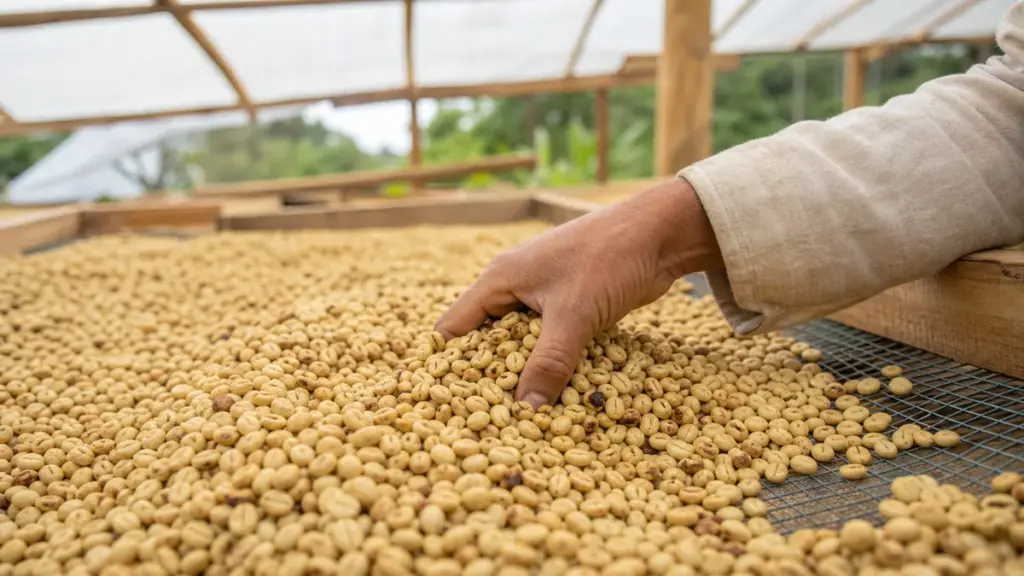
Processing provides another layer of experimentation. Washed processing removes the fruit skin and pulp, then removes the sticky mucilage surrounding the seeds before drying. Current FRINJ releases include traditional washed coffee, washed lots fermented with added yeast, and an enzyme-assisted washed Geisha.
These are not interchangeable descriptions. Added yeast is a fermentation choice; “washed” describes the broader processing route. Ask for the actual lot information rather than assuming every experimental process produces the same taste.
How small is the industry?
Small enough that counting plants, participating farms and producing farms gives very different impressions.
In June 2018, University of California reporting quoted Gaskell’s estimate of about 30 farms and 30,000 coffee plants between San Luis Obispo and San Diego counties. That is a historical snapshot, not a current total.
A March 2026 interview in the Santa Barbara Independent reported a FRINJ network of approximately 45 farms, of which 24 contributed to the 2025 harvest. The same report gave approximately 2.3 tonnes of sellable coffee, converted from the published figure of about 5,000 lb.
Those figures describe one company’s reported network and output, not an independently audited California production total. They also explain why older references to larger partner networks should not be repeated as if every participating farm were harvesting commercially.
Fruit and finished coffee must also be kept separate. A harvest weight of coffee cherries includes fruit material that does not become saleable beans. Comparing cherry tonnage directly with green coffee production would exaggerate the scale.
What does California coffee taste like?
There is evidence that California can produce well-regarded coffee, but not enough to prescribe one dependable regional flavour.
The university’s account of Good Land Organics’ 2014 Coffee Review recognition is a useful historical quality marker. It does not certify subsequent harvests or every farm using similar varieties.
For a more concrete picture, these current producer descriptions show how widely individual lots can differ.
| Named coffee | Processing described by FRINJ | Producer’s reported tasting notes |
|---|---|---|
| Knopf Knoll Ranch Catuaí Rojo, Carpinteria | Traditional washed | Green apple, white flowers, clover honey |
| Mraz Family Farms field blend, Oceanside | Yeast-inoculated washed | Pear, nougat, malted chocolate |
| Vedder Ranch Geisha, Carpinteria | Enzyme-assisted washed | Lime, star jasmine, brown sugar |
These are producer-reported sensory descriptions, not independent comparative findings or our own tasting notes. A field blend also combines varieties, making it a different proposition from a separately processed single-variety lot.
The sensible conclusion is that California offers several flavour possibilities. Variety, fruit selection, fermentation, drying and roasting are all present in the cup; separating their effects from the growing site requires more than an attractive origin story.
Challenges, premium positioning and buying sensibly
Climate and water
Coffee’s suitability depends on avoiding damaging extremes. University guidance identifies freezing temperatures, hot dry winds, soil conditions and consistent watering as practical concerns.
Avocado intercropping does not make the coffee rain-fed or prove that its environmental impact is low. Any claim about water efficiency needs measured evidence for the particular growing system, rather than an assumption based on shared orchard space.
Picking and post-harvest work
University guidance recommends selecting fully ripe cherries and sorting unsuitable fruit before processing. That creates a labour requirement, particularly where fruit does not all ripen together.
The work continues after picking. Pulping, fermentation, washing, drying and sorting must turn perishable fruit into stable coffee. Current FRINJ descriptions identify a Ventura mill, illustrating the importance of shared processing infrastructure as well as successful farming.
Why it occupies a premium niche
FRINJ attributes its premium positioning to California land and labour requirements, small lots and the work involved in establishing a new origin. These are the company’s explanations, not proof that every bag offers exceptional sensory quality.
For UK readers, the most useful buying checks are straightforward:
- Confirm the growing origin. “Roasted in California” is not the same claim as “grown in California”.
- Identify the farm and lot. Prefer a named producer, variety or clearly described field blend, and processing details.
- Check harvest and roast information separately. They answer different questions about the coffee’s history.
- Ask whose tasting notes you are reading. Producer descriptions and independent assessments are different kinds of evidence.
- Confirm UK delivery arrangements before ordering. For trade purchases, request an itemised written quotation covering supply and delivery.
For another regional reference point, explore Mexican coffee, without assuming that it provides a ready-made template for California.
California coffee is most interesting when bought as a traceable agricultural experiment with a specific cup to offer, not simply as a geographical curiosity.
FAQ
Is coffee grown in California the same as coffee roasted there?
No. Growing origin identifies where the coffee plants produced their fruit; roasting location identifies where the processed beans were roasted. A California roaster may sell imported beans. For genuinely California-grown coffee, look for an explicit growing-origin statement, preferably supported by a named farm and a clear lot description.
Can I grow California coffee varieties outdoors in the UK?
Do not assume California’s experience makes these plants suitable for an exposed UK garden. University of California guidance warns that freezing conditions can damage or kill coffee plants. The lesson from California is the importance of a protected growing environment, not that arabica has become a frost-hardy crop.
Does “Good Land Organics” mean all California coffee is organic?
No. A business name does not establish the certification status of other farms or of an entire origin. FRINJ states that it sources from both certified organic and conventional farms. If certification matters to you, check the claim and supporting documentation for the particular coffee rather than relying on a regional description.
Where to go next
Read North America to place California within the wider region. Continue with Mexico for a neighbouring origin with its own regional distinctions and growing traditions.
Sources
- University of California Cooperative Extension, Santa Barbara County Cooperative Extension: Quarterly Report October to December 2015, 2015. Historical collaboration and early development. Report PDF.
- University of California Agriculture and Natural Resources, UCCE small farms advisor Mark Gaskell retires, 29 June 2018. Ruskey’s account of the 2002 plants, historical scale and Coffee Review recognition. University article.
- University of California Cooperative Extension, Ventura County, Coffee, undated. Coastal climate, wind, irrigation, harvesting and production challenges. Extension guidance.
- University of California Cooperative Extension, Ramiro Lobo and Othoniel Pacheco, Coffee (Coffea arabica): A New Crop for Southern California, presentation dated 16 July 2020. Climate, harvesting and processing. Presentation PDF.
- Food GPS, Joshua Lurie, Interview: Good Land Organics Farmer Jay Ruskey Discusses Growing Coffee in Santa Barbara County, 18 May 2011. Primary grower interview covering elevation, varieties and practical challenges. Interview.
- FRINJ Coffee, Our Story and Coffee FAQ, undated, retrieved November 2026. Farm locations, varieties, harvest guidance, premium positioning and certification distinctions. Our Story; Coffee FAQ.
- United States Bankruptcy Court, Central District of California, Courtroom 201 Calendar, 25 March 2025, FRINJ Coffee proceedings. Records the Chapter 11 petition date. Court calendar PDF.
- Law Offices of Michael Jay Berger, Chapter 11, undated case account, retrieved November 2026. First-party legal representative’s account of FRINJ’s plan confirmation on 31 January 2025. Case account.
- FRINJ Coffee, FRINJ Coffee Mourns the Loss of Its CEO and Spouse, company announcement dated 16 February 2026, reproduced by Business Times Journal. Ruskeys’ deaths, founding year and Ventura County facility. Company announcement.
- Santa Barbara Independent, What’s the Future of Frinj Coffee?, 18 March 2026. Attributed management interviews covering network size, the 2025 harvest and restructuring. Reported interviews.
- World Coffee Research, Arabica Varieties Catalog: Caturra, Catuaí and Geisha (Panama), live entries, undated, retrieved November 2026. Variety identities and Geisha lineage distinctions. Caturra; Catuaí; Geisha.
- FRINJ Coffee, named-lot descriptions, undated, retrieved November 2026: Knopf Knoll Ranch: Traditional Washed Catuaí Rojo; Mraz Family Farms: Yeast Washed Field Blend; Vedder Ranch: Enzyme Washed Geisha. Primary product information, processing descriptions and producer tasting notes. Knopf Knoll; Mraz Family Farms; Vedder Ranch.
This article was researched using university extension publications, a primary grower interview, court records, first-party company and legal statements, attributed reporting and World Coffee Research’s variety catalogue; producer tasting notes were not treated as independent testing.
Last checked: November 2026