Good coffee posters and prints are worth seeking out from named artists, specialist print publishers and sellers who clearly identify the artwork’s source. Start with botanical illustrations for plant detail, vintage-style designs for café character or minimal prints for a quieter wall, then check authorship, dimensions and framing before ordering.
In short
- Choose the style first: botanical, vintage or minimal, rather than searching only for “coffee wall art”.
- Look for a named artist or an identifiable historical source, with a clear explanation of what is being reproduced.
- Check whether you are ordering a physical print, a framed picture or a digital download.
- Confirm paper size, image size and finished frame size separately.
- Keep framed paper away from direct sunlight, radiators and the steam rising from coffee equipment.
Choose a style of coffee print
The most useful starting question is not “Which coffee poster is best?” but “What do I want this wall to feel like?” A detailed plant illustration, a bold advertising-style design and a spare drawing of an espresso cup make very different statements.
For the wider range of objects beyond wall art, start with coffee merchandise and gifts. Here, the focus is choosing a picture that deserves its place on the wall.
The following comparison uses subject matter, visual character and the checks worth making before purchase. The suggestions about where each style belongs are editorial judgement, not rules of interior design.
| Print style | What to look for | Who it suits | Main buying check |
|---|---|---|---|
| Botanical | Plant studies, leaves, flowers and fruit details | Someone interested in coffee as a crop | Is the plant identified and the illustration attributed? |
| Vintage or vintage-style | Advertising layouts, bold lettering and period-inspired colours | Someone who enjoys café graphics | Is it an old sheet, a modern reproduction or a new retro design? |
| Minimal | Simple cups, brewing shapes, line drawings and limited colours | Someone wanting a restrained coffee reference | Does the actual artwork look convincing beyond the room mock-up? |
Botanical: coffee before the cup
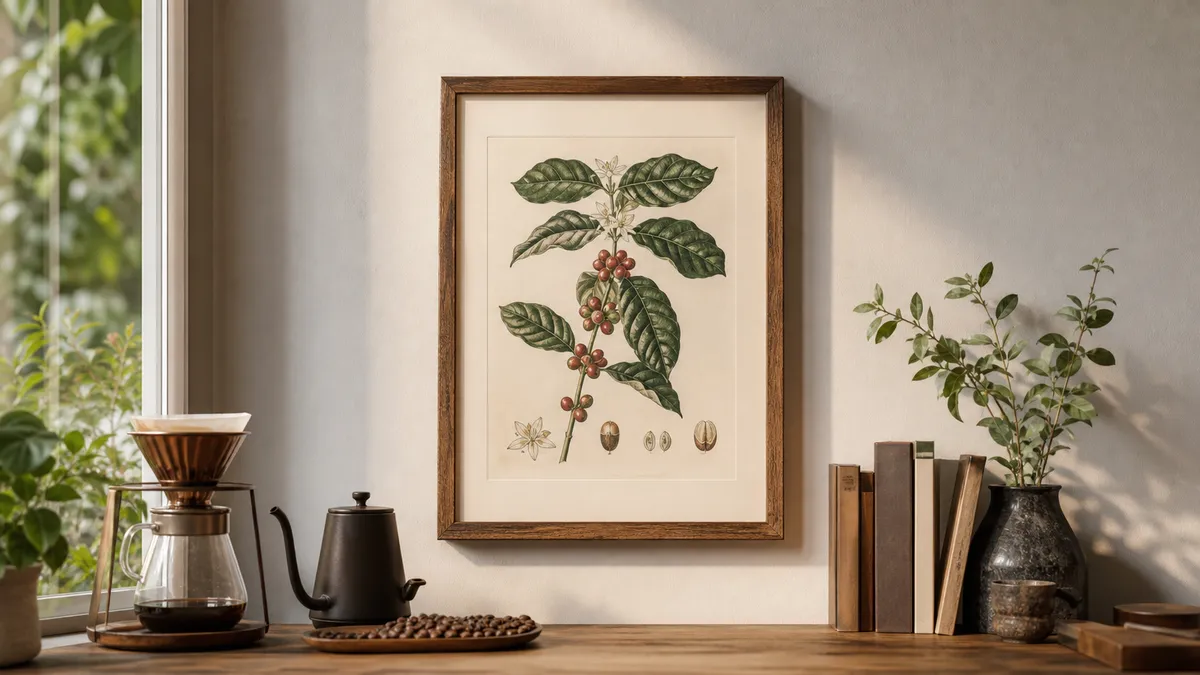
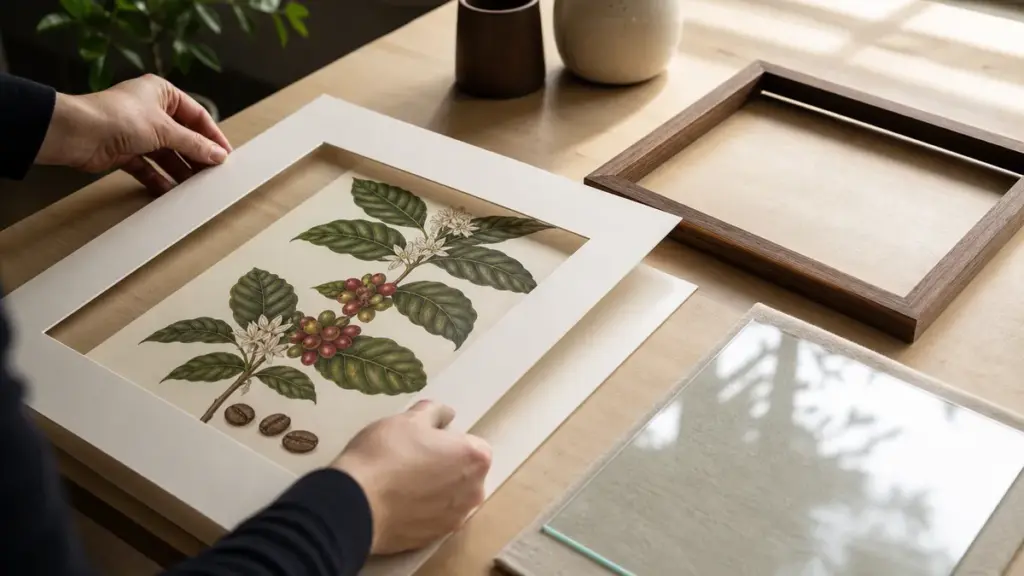
Choose botanical work if the plant interests you as much as the drink. Look for an illustration with a clear subject and enough detail to reward a closer look, rather than a generic leafy branch carrying a coffee-related caption.
For a historical reproduction, ask which publication or collection supplied the image. If the seller describes it as a scientific plate, request the original attribution rather than assuming that an aged background makes it authoritative.
A botanical print is my preference for a room that already contains plenty of coffee equipment. It adds another aspect of coffee without repeating the machine, grinder and cups below it.
Vintage: distinguish the object from the look
“Vintage” needs unpacking. Ask whether the listing offers a genuinely older printed sheet, a newly printed reproduction of an older image or a contemporary design made to look retro.
All three can be attractive, but they are different purchases. If you want a historical object, request photographs of the actual sheet and a condition description, including any tears, staining, repairs or trimming.
If you simply like the visual style, a clearly described modern reproduction is a straightforward choice. You need not acquire an old object to enjoy an old-fashioned coffee graphic.
Minimal: make the details earn their place
For a minimal print, look closely at line quality, spacing and the relationship between the image and the blank paper around it. Ask for an unobstructed view of the artwork, not just a picture of it hanging above furniture.
My suggestion is to choose one recognisable coffee detail rather than several competing motifs. A simple cup or brewing silhouette can be enough; the wall does not need to become a drinks menu.
Where to buy coffee posters and prints
Use attribution, clear product information and suitability for your wall as the selection criteria. The examples below are verified starting points, not a ranking or a claim that their finished prints have been independently tested. Listings were checked in November 2026; confirm the current options before ordering.
East End Prints for contemporary illustration
East End Prints lists Coffee? by Sophie Deller, a contemporary illustration featuring coffee cups and expressive lettering. The product page identifies the artist and offers unframed and framed options.
This is a useful starting point if you want a named contemporary illustrator rather than an anonymous decorative image. Its paper, ink and production descriptions are the publisher’s claims, so read the selected product specification rather than treating the general word “quality” as sufficient evidence.
King & McGaw for retro coffee graphics
King & McGaw’s Retro Series includes Cup’pa Joe to Go and Cup’pa Joe Best in Town. These provide a starting point for readers drawn to advertising-style coffee imagery.
Choose the design because you enjoy its composition, then confirm the selected print and frame details. Do not infer the age or rarity of the physical object from a retro-looking image.
VictorianMaps for a botanical reproduction
VictorianMaps lists a Coffea arabica botanical image as a restored reproduction of an antique plate. The useful distinction is that its description identifies the product as a reproduction, not the original historical sheet.
Consider this route if you like older botanical illustration. If historical provenance matters to your purchase, ask for the original publication details before ordering; the seller’s description alone is not independent authentication.
Etsy and direct artist shops
On Etsy, assess the individual seller, not just the platform. Etsy’s Seller Policy requires accurate information about how an item was made and disclosure when artificial intelligence was used, but the policy is not proof that a particular listing complies.
Use marketplace searches to discover artists, then inspect their profiles, process descriptions and product photographs. Where possible, compare the listing with the artist’s own website or portfolio.
For direct purchases, ask who created the image, who prints it and what arrives in the parcel. A clear answer is more useful than a long string of decorative adjectives.
Check originality and licensing
There are two separate questions: who created the image, and what kind of object are you buying?
An original artist’s print, such as a linocut or screenprint, is not simply a reproduction of a painting. St Jude’s explains the distinction through work created for a printing process and printed by the artist or under their supervision.
A giclée is an inkjet print. It may reproduce an artwork made in another medium, while digital printing can also be the intended final form of an artist’s work. The process name alone does not establish originality.
Before buying, ask:
- Who is the artist, illustrator or photographer?
- Is this an original print, a reproduction or a digitally created artwork?
- If an edition is limited, what is its stated size?
- If the image comes from an archive, what is the source?
- If the seller is not the creator, how are they authorised to reproduce it?
For UK copyright purposes, owning the physical picture does not automatically give you permission to reproduce the image. Buying a print for a wall is different from acquiring permission to put that artwork on mugs, packaging, staff merchandise or a website.
For a digital download, read the licence before sending the file to a printer. Ask whether your intended printing and use are permitted, and retain the licence with your order confirmation. For a specific commercial-use question, seek advice from a qualified legal professional.
Choose the size and frame together
Start with the intended wall, not the largest size offered. Mark out the proposed finished frame dimensions with a paper template and view it from the doorway and your usual seat.
Ask the seller to distinguish:
- Paper size: the dimensions of the complete sheet.
- Image size: the area occupied by the artwork.
- Mount opening: the part visible through the surrounding board.
- External frame size: the complete object you will hang.
Do not trim a print to fit a frame without considering whether you would remove a border, signature or edition marking.
For a botanical illustration, I would start with a plain timber frame and an unobtrusive mount. For a bold graphic, a narrow dark frame may suit the composition better. These are aesthetic suggestions: choose a frame that supports the picture rather than competing with it.
For an original, signed edition or sentimental print, discuss preservation framing with a professional framer. The Library of Congress recommends chemically stable framing materials and protection from environmental risks, including light, water and humidity.
Keep the picture away from direct sunlight and radiators. Beside a coffee station, choose a position outside the path of steam and splashes, rather than immediately above the machine.
For room-wide styling rather than print selection, see coffee art and home décor.
A final checklist before ordering
Work through these steps for each shortlisted print:
- Identify the item. Confirm physical print, framed picture or downloadable file.
- Check the creator. Look for a named artist or a clearly attributed historical source.
- Inspect the artwork. Request a close view showing detail without a room mock-up.
- Confirm the specification. Ask about paper, printing process, borders and included framing.
- Measure the finished object. Include the mount and frame, not just the printed sheet.
- Read the fulfilment terms. Check dispatch arrangements, packaging, returns and the procedure for transit damage.
- Keep the records. Save the listing, order confirmation and any reproduction licence.
For a gift, ask about the recipient’s wall space and preferred colours before choosing a large framed piece. If you are unsure whether wall art is right for them, coffee-themed gifts offers a broader starting point without turning this purchase into guesswork.
FAQ
Is a signed coffee print necessarily an original?
No. A signature alone does not tell you whether the item is an original artist’s print or a reproduction. Ask how the artwork was made, what process produced the sheet and whether the artist signed it by hand. A signed reproduction may still be enjoyable to own, provided it is accurately described.
Can I order a digital download and have it printed locally?
Yes, if the licence permits your intended use. Before ordering, send the printer the file details and proposed dimensions so they can assess suitability. Confirm whether any cropping is needed and request a proof if colour or fine lettering matters. Keep the seller’s permission and printing instructions with the file.
How should I check a coffee print when it arrives?
Inspect it before framing or discarding the packaging. In good light, check the sheet for creases, damaged corners, surface marks and unexpected cropping, then compare it with the order description. Photograph any damage and retain the packaging while contacting the seller. Follow the seller’s reporting procedure rather than attempting a repair.
Where to go next
For planning the surrounding space, read Coffee Art and Home Décor; for a wider choice of presents, try Coffee-Themed Gifts. If wall art is not quite right, Coffee-Designed Mugs explores useful decorative objects, while Coffee Gift Sets covers gifts built around several complementary items. Choose coffee posters and prints when the picture itself, not just its coffee theme, feels right for the recipient or room.
Sources
-
East End Prints, Coffee? by Sophie Deller, undated product page, retrieved November 2026.
https://eastendprints.co.uk/products/coffee.html -
King & McGaw, Retro Series Art Prints and Posters, undated collection page, retrieved November 2026.
https://www.kingandmcgaw.com/prints/retro-series -
VictorianMaps, Antique Coffee Plant Art Print Poster Coffea arabica, undated product page, retrieved November 2026.
https://victorianmaps.com/products/coffee-antique-botanical-print-coffea-arabica-plant-art-poster-decor-gift -
Etsy, Seller Policy, live policy retrieved November 2026.
https://www.etsy.com/legal/sellers -
St Jude’s Prints, What is an original artist’s print?, undated explanatory page, retrieved November 2026.
https://www.stjudesprints.co.uk/collections/what-is-an-original-artists-print -
GOV.UK, Using somebody else’s intellectual property: Copyright, undated guidance, retrieved November 2026.
https://www.gov.uk/using-somebody-elses-intellectual-property/copyright -
Intellectual Property Office, Copyright notice: digital images, photographs and the internet, updated 4 January 2021.
https://www.gov.uk/government/publications/copyright-notice-digital-images-photographs-and-the-internet/copyright-notice-digital-images-photographs-and-the-internet -
Library of Congress, Preservation Guidelines for Matting and Framing, undated collections-care guidance, retrieved November 2026.
https://www.loc.gov/preservation/care/mat.html
Researched using live seller listings, UK copyright guidance and institutional preservation advice; product descriptions are attributed to sellers, and no physical print testing was undertaken.
Last checked: November 2026