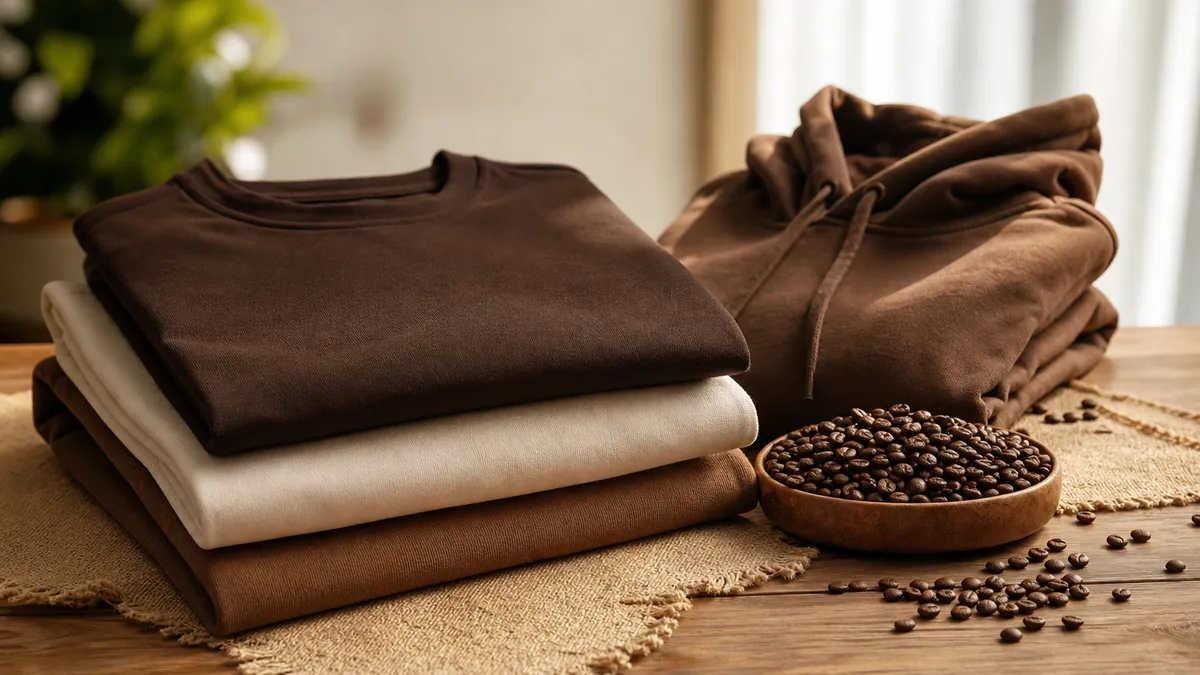
Choose coffee t-shirts and hoodies as clothes first and coffee merchandise second: look for a suitable fabric, clear measurements and a well-executed design. Before ordering, check how the decoration is applied, what any ethical certification actually covers, and whether the seller shows the finished garment rather than only a digital preview.
In short
- Compare garment measurements in centimetres with clothing you already wear, rather than relying on a familiar size letter.
- Read the fibre composition for your chosen colour, and ask whether the hoodie has a brushed or loopback interior.
- Match the decoration to the artwork: detailed illustrations, bold graphics and small embroidered motifs need different treatment.
- Distinguish organic fibre certification, textile processing standards and testing for harmful substances.
- When buying from an independent maker, ask who designed, manufactured and decorated the garment.
Start with the garment, not the slogan
A coffee illustration should be the reason you notice a garment, not the reason you overlook an uncomfortable neckline or an unsuitable fit. Decide where you expect to wear it: under an overshirt, around the office, outdoors between buildings, or simply at home.
For a t-shirt, consider the neckline, sleeve length, body length and how closely you want it to fit. For a hoodie, decide between a pullover and a zip-through, then consider the hood, pockets and room for another layer underneath.
Our coffee merchandise guide covers the wider category. Here, the useful distinction is between clothing you genuinely want to wear and a novelty design that happens to be printed on clothing.
Materials: read beyond “premium cotton”
Start with the fibre composition, not an adjective such as “premium”. Cotton, cotton-polyester blends and other mixed fabrics are not interchangeable, particularly when the garment is also being used as a printing surface.
Printful’s production guidance says its direct-to-garment printing generally gives a more opaque result on cotton, while blends can produce a softer, washed-out appearance. That is useful context when comparing a crisp coffee illustration with a deliberately faded, vintage-style design, but it is not proof of how another printer’s garment will perform.
Check the composition of the particular colour you want. If the listing groups several colours together, ask the maker to confirm that the fibre information applies to your selection.
Fabric weight and hoodie interiors
Fabric weight is often given as GSM, meaning grams per square metre. This describes the mass of an area of fabric, not the total weight of the finished garment, and a higher figure is not a quality score.
Use it to compare otherwise similar garments. Ask whether you want a light layer or a more substantial feel, then judge the cut, fabric construction and decoration alongside the stated weight.
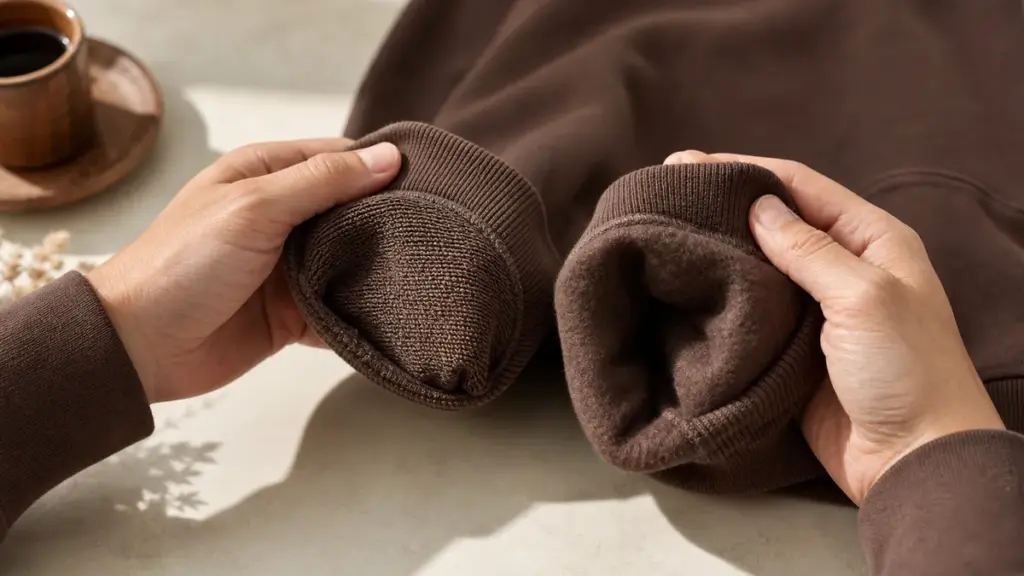
For hoodies, look for an interior photograph. French terry, often called loopback, has loops on the inside; brushed fleece has a raised, fuzzy inner surface. Choose according to the feel you prefer rather than assuming every hoodie has the same lining.
If the description is vague, ask for a close-up of the inside cuff or hem. A straightforward photograph is more useful than another paragraph calling the fabric luxurious.
Printing quality: match the method to the design
Assess decoration against four criteria: suitability for the artwork, clarity, placement and the feel of the finished surface. No printing method makes an otherwise poorly produced garment a good purchase.
The comparison below is a starting point, not a durability ranking.
| Decoration | What it does | Coffee designs it suits | What to inspect |
|---|---|---|---|
| Screen printing | Transfers ink through a mesh stencil | Bold bean shapes, simple brewer illustrations and solid-colour graphics | Clean edges, aligned colours and consistent coverage |
| Direct-to-garment, or DTG | Prints ink directly onto the garment | Detailed illustrations and artwork with tonal changes | Fine detail, colour coverage and a real printed sample |
| Embroidery | Builds the design with stitches | Small cup, bean or brewer motifs | Clear shapes, tidy stitching and fabric that lies flat |
Screen printing is a sensible method to investigate for bold artwork, while DTG suits detailed, multicoloured images. Embroidery offers a stitched alternative, but tiny gaps and intricate details need particular care: Printful’s embroidery guidance identifies distortion and puckering among possible design problems.
Ask for photographs of the actual decoration at close range and of the whole garment. The first helps you inspect execution; the second shows whether the design looks appropriately sized and positioned.
For a hoodie, check how the artwork relates to the pocket and zip. For a t-shirt, look at where the illustration sits relative to the neckline and side seams. Treat a digital preview as a proposal for the appearance, not evidence of the finished result.
Be cautious about unsupported promises that a print will last indefinitely. Ask whether the maker has washed a production sample, what care instructions were followed and whether photographs are available.
Sizing: compare like with like
Use a garment you already like as your reference. Printful’s measurement guidance distinguishes flat chest width, measured across the garment, from body measurements taken around the wearer.
Before comparing figures, establish whether the seller’s chart describes the person or the clothing. A flat width and a chest circumference are different measurements.
Follow this sequence:
- Lay a well-fitting t-shirt or hoodie flat without stretching it.
- Measure across the chest from armpit to armpit.
- Measure the length using the same starting point shown in the seller’s diagram.
- Compare sleeve measurements where supplied, checking how they are taken.
- Ask about measurement tolerances and any shrinkage information before ordering.
Measure a hoodie against another hoodie if you intend to wear it over a t-shirt. That is more useful than comparing it with a close-fitting base layer.
Treat “unisex”, “relaxed” and “oversized” as descriptions to investigate through the chart, not instructions to select your usual size. If sleeve or body length matters particularly to you, ask for that measurement explicitly.
For a gift, request measurements from the recipient if practical. If sizing would spoil the surprise, check the exchange arrangements before committing.
Ethical and organic cotton: understand the evidence
“Organic”, “ethical” and “tested for harmful substances” answer different questions. Look for the named scheme, a verifiable certification reference and an explanation of which product or production stage is covered.
Organic content and processing
The Global Organic Textile Standard, or GOTS, combines requirements for organic fibre content with environmental and social criteria for textile processing. Its “Organic” label grade requires at least 95% certified organic fibres; the “Made with Organic” grade starts at 70%.
The Organic Content Standard, or OCS, tracks certified organic material through the supply chain. Textile Exchange explains that a final-product OCS claim requires certification through to the brand. It should not be read as an all-purpose guarantee about every aspect of garment manufacture.
Ask a decorator whether certification covers the finished coffee garment or only the undecorated garment, often called the blank. GOTS includes requirements for dyeing and printing, so the distinction matters.
Chemical testing is a separate question
OEKO-TEX STANDARD 100 concerns testing textiles and their components for harmful substances. Its certificate number can be checked through the scheme’s Label Check service.
Do not use that label as a substitute for evidence of organic fibre content or working conditions. Equally, do not assume that an organic-content claim tells you everything about the printing process.
For wider ethical claims, ask where the garment was made, who decorated it and what evidence supports the seller’s statements. Prefer a specific, checkable explanation to broad descriptions such as “planet-friendly”. An organic percentage alone does not establish the total environmental impact of the finished hoodie.
Designs: choose something you will still want to wear
Start with the wearer’s relationship with coffee. Would they prefer a discreet bean motif, a botanical illustration, a recognisable brewing tool or a large piece of graphic artwork?
For an understated wardrobe, consider a small chest design in a restrained colour. For someone who already wears illustrated clothing, a larger back print may be a better match. These are style choices, not quality differences.
Look closely at the subject. If you care about brewing equipment, make sure the illustrated brewer actually resembles the equipment you enjoy. If you prefer botanical artwork, examine the drawing rather than accepting a generic description.
Also consider how the design works with the garment colour. Ask for a real sample photograph when contrast or fine detail is central to its appeal.
For bags, hats and other wearable items, see coffee apparel and accessories. If the recipient enjoys coffee artwork but rarely wears graphic clothing, consider coffee art for the home instead.
Independent makers: ask who does what
To find independent makers, start with an illustrator’s own shop, a local print studio or the merchandise section of a roaster you already know. Then apply the same checks you would use anywhere else.
Separate three questions: who created the artwork, who made the blank garment and who applied the decoration? An independent designer can explain their contribution without suggesting that they also grew the cotton or sewed the hoodie.
Ask whether the design is original or licensed, and look for an artist credit where relevant. If supporting a particular creative business matters to you, buy through a channel that clearly identifies that business.
Useful questions include:
- Can I see photographs of the finished garment?
- Which blank garment and fibre composition are used?
- Where is it decorated and dispatched?
- Are orders held in stock or produced after purchase?
- Who handles sizing queries, faults and returns?
Neither independent ownership nor production after ordering is, by itself, evidence of print quality or ethical manufacture. Judge the answers and supporting information.
For a gift where the clothing preferences remain uncertain, coffee-themed gift ideas provide a broader starting point.
A final checklist before ordering
Save the product description, measurement chart and care instructions so you can compare them with what arrives.
Before placing the order, confirm:
- Fabric: the composition and interior finish are clear.
- Fit: the measurements match clothing you enjoy wearing.
- Decoration: the method is named and finished examples are visible.
- Claims: certification details relate to the product being offered.
- Seller: contact, dispatch and return arrangements are understandable.
UK government guidance says that, for most online purchases, customers can notify the trader of cancellation within 14 days of receiving the goods, then have another 14 days to return them. Personalised or custom-made goods can be excluded from change-of-mind returns, but that does not remove rights concerning faulty goods.
Read the garment-specific care instructions before washing. For its DTG products, Printful recommends a cold, gentle wash inside out with mild detergent, followed by hang-drying or low-temperature tumble-drying; it also advises against ironing the print directly.
The best coffee t-shirts and hoodies should pass both tests: you like the coffee design, and you would still choose the garment underneath it.
FAQ
Is a washed-out coffee print necessarily faulty?
No, a washed-out appearance can be an intended result. Printful explains that DTG printing on blended fabrics can look softer and more faded than on cotton. Compare the item with the description and finished-product photographs, then ask the seller about any unexpected patchiness or loss of detail before washing it.
What should I ask before ordering matching clothing for a team?
Ask for a physical sample, individual garment measurements and written confirmation of the decoration placement. Check whether every selected size and colour uses the same fabric composition. Agree how substitutions, delivery and faults will be handled, and get an itemised written quotation rather than relying on a general product listing.
Should I remove the labels before giving a coffee hoodie as a gift?
Keep the care label intact and check the seller’s return conditions before removing other tags. Include the care instructions and explain how the recipient can arrange an exchange if the seller offers one. GOV.UK notes that a trader generally only has to accept a return from the person who bought the item, so retain the order details.
Where to go next
Read Coffee Merchandise and Gifts for the wider buying framework, or Coffee Apparel and Accessories to compare clothing with other wearable items. Coffee-Themed Gifts is useful when fit makes clothing an uncertain present, while Coffee Art and Home Décor offers alternatives for someone who prefers their coffee illustrations off the wardrobe.
Sources
All undated web guidance below was retrieved and checked in November 2026. Production advice from Printful describes its own processes and is not independent testing of coffee merchandise.
-
Printful, “How much does a shirt weigh? T-shirt weight guide”, web guide, checked 2026.
https://www.printful.com/uk/blog/t-shirt-weight-guide -
Printful, “Different types of hoodies explained”, web guide, checked 2026.
https://www.printful.com/uk/blog/types-of-hoodies -
Printful, “How does fabric blend affect print quality?”, Help Center guidance, undated.
https://help.printful.com/hc/en-us/articles/50264412577553-How-does-fabric-blend-affect-print-quality -
Printful, “DTG vs screen printing: Which one to choose?”, web guide, checked 2026.
https://www.printful.com/uk/blog/dtg-vs-screen-printing -
Printful, “Your Ultimate Graphics and Embroidery Guide”, production guidance, undated.
https://www.printful.com/graphics-and-embroidery-guide -
Printful, “How to measure a t-shirt for successful selling”, web guide, checked 2026.
https://www.printful.com/uk/blog/how-to-measure-a-t-shirt -
Global Standards, “GOTS labelling”, current web labelling guidance, undated.
https://global-standards.org/our-standards/gots/labelling -
Global Standards, “GOTS: How the programme works”, current web programme guidance, undated.
https://global-standards.org/our-standards/gots/how-it-works -
Textile Exchange, “How organic cotton certification works”, certification guidance, undated.
https://textileexchange.org/organic-cotton-certification/ -
OEKO-TEX, “OEKO-TEX STANDARD 100”, current scheme guidance, undated.
https://www.oeko-tex.com/en/our-standards/oeko-tex-standard-100 -
GOV.UK, “Accepting returns and giving refunds: the law”, current UK government guidance, undated.
https://www.gov.uk/accepting-returns-and-giving-refunds -
Printful, “How do I take care of my products?”, Help Center guidance, undated.
https://help.printful.com/hc/en-us/articles/50263252811537-How-do-I-take-care-of-my-products
This guide was researched using textile certification organisations, UK government consumer guidance and a decoration supplier’s published technical advice; no garments were independently tested.
Last checked: November 2026